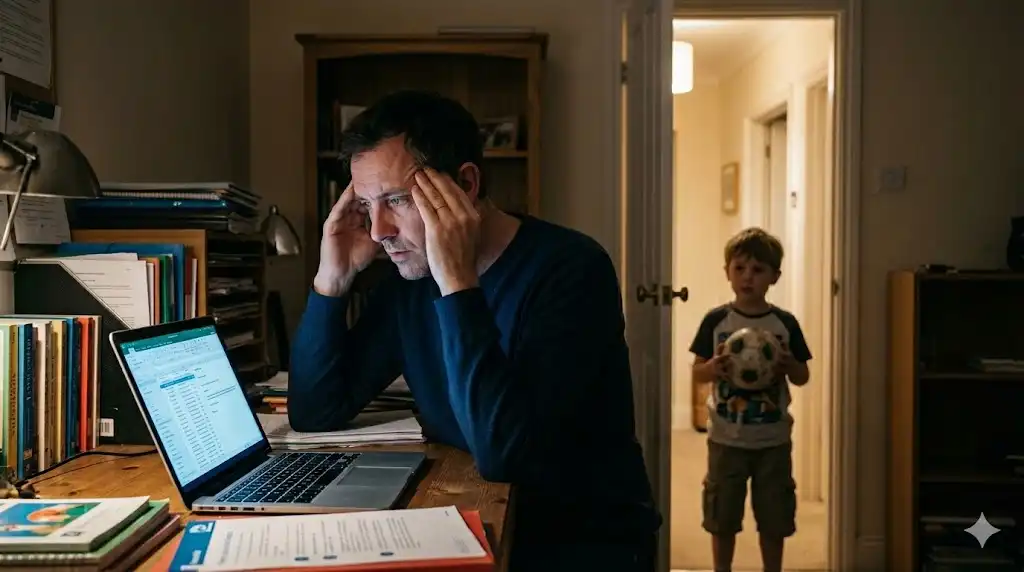
Not so long ago, I was sitting in bed on a Saturday morning drinking a cup of tea and preparing mentally for the day. I looked over at my wife who, with phone in hand, was absentmindedly scrolling through her Instagram feed. I watched as she scrolled through ad after ad. I counted about 20 adverts, one after the other, before a single, solitary news update from one of her friends appeared. This was then followed by about another 20 adverts. She didn’t seem to be the least bit surprised or annoyed about this; the action of scrolling was completely automatic and the acceptance of the ads was subconscious and total. I don’t know why that particular Saturday morning was such a watershed for me, but somehow it changed me. A watershed is an event or a moment that marks a turning point in a person’s life. I sat there, mesmerised, watching my wife scrolling and scrolling. After a few minutes, she noticed that I was looking over her shoulder. She put the phone down on the bedside table and asked, ‘Is everything okay?’
Everything was not okay. I was angry. Not with her and not even with Instagram. I was angry with myself because I recognised that it could just as well have been me scrolling. I was angry about the fact that I allowed the creeping normality of frictionless distraction to invade my life so often. I was angry because somehow I found myself inviting and welcoming this junk into my reality, every single day. When I watched my wife scrolling I thought, ‘Why does she put up with this slop?’ Yet I was unable to turn that criticism against myself and do something about it in my own life. At the core of my anger was a sense of self-disgust and shame. It wasn’t as though I didn’t have any choice or agency in the matter. It’s not like I was forced to consume unwanted adverts against my will. Accepting that fact was what made me feel ashamed. How could I, a 52-year-old man, be such a slave to something that I didn’t even like? How could that be possible?
Charles Dickens’s novel A Tale of Two Cities begins with the iconic phrase, ‘It was the best of times, it was the worst of times…’ It has become one of the most famous quotes of all time and is often used to communicate the idea of paradoxes, dualities and social contradictions.
I believe that this quote perfectly encapsulates the reality in which we currently live. The digital tools that we have at our fingertips are both wonderful and terrible. They are both the problem and the solution. In terms of access to knowledge and capacity for personal improvement through self-teaching, we live in the best of times. The speed at which we can obtain answers to any question or any problem is nothing short of astonishing. And yet, the speed at which we can access distracting, unhelpful, harmful and destructive content is nothing short of frightening. In this respect, we also live in the worst of times.
I have never woken up in the morning and said to myself, ‘Today, I’m looking forward to watching lots of adverts on social media for products I don’t want’. Likewise, I have never said to myself, ‘I can’t wait to fill my head with lots of short videos about horrific doomsday scenarios that will consume my thinking time and make me feel negative for the rest of the day’.
I have said that I consider it a privilege to be a Gen Xer. But the privilege only has value for me if I admit to myself that I have allowed the attention economy to invade my mind, my heart and my soul. Then, having admitted to myself that I have done this, I need to give myself a little space to grieve the lost time that I have willingly given to the ruthless and cynical corporate machines that have exploited my weaknesses to shove down my throat as much slop as I’m willing to swallow. And finally, I need to reset my mind so that I can – once and for all – stop consuming the digital junk and instead start using the good digital tools to grow and develop again.
When considering technological developments, 2020 is already a relatively long time ago. It was the year that Netflix released the documentary The Social Dilemma. I remember watching it with a sense of shock and outrage. It was through this documentary that I learned how social media companies had created AI algorithms that were trained to teach themselves how to become better and better at feeding users what they wanted. These algorithms started developing and improving themselves exponentially and became extraordinarily complex. One of the general messages of The Social Dilemma was that the social media companies metaphorically shrugged their shoulders as these uncontrolled algorithms went rogue and started diabolically tailoring people’s feeds, using parameters of such complexity that the humans who had set them in motion no longer understood how they worked. But, if the end product was that more people were spending more of their time on social media, who cared? The breathtaking cynicism of this attitude shook me, back then when I first watched the documentary. I’m not a programmer or a coder but, even then, I understood that if my eyes paused even for a fraction of a second on an image or a video, or if I stopped scrolling momentarily to watch a piece of content, every tiny movement or pausing of my hand or eyes would be used to calculate a more addictive cocktail of content to present to me the next time I opened a social media app. I knew all this, and I still didn’t do anything about it.
But how did I reach this point of such apparent helplessness?
There’s an apologue about a frog which is very slowly boiled alive. The frog is placed into cold water, which is heated so slowly that the frog doesn’t notice the temperature increase until it’s killed by the heat. An apologue is a short allegorical story with exaggerated details, intended to serve as a vehicle for some moral point that is driven home by the teller. The boiling frog story is an apologue intended to demonstrate creeping normality: the very slow process through which something changes from being okay to being deadly, but in such a way that it continues to feel normal even when it is having catastrophic consequences on us. It turns out that the boiling frog story is largely untrue; modern experiments have shown that frogs have an internal warning system that will alert them to danger in such a way that they will always try to escape from water heated beyond a certain point.
However, I don’t seem to have an internal warning system that kicks in when I expose myself to digital content that is, empirically, deadly in the long term. So, the premise that creeping normality can cause us humans to accept things that are actually destructive to us is most certainly true. When a person creeps, they move slowly and stealthily, in a way that is intended not to be noticed. When normality creeps, it changes slowly and stealthily in a way that goes unnoticed. The anger and self-disgust I felt when I was watching my wife scrolling on her phone was not simply shock at the realisation that I’d been so affected by creeping normality; it was the recognition that I’d watched The Social Dilemma five years previously and still not cared enough to change my habits. I knew about the algorithms and the strategies used by social media companies. I wasn’t slowly being boiled alive against my will. I was turning up the temperature myself.
Arguably, this process started in 2007. ‘I have one particular memory of the moment when a family member persuaded me to join Facebook in 2007’. It was in 2007 that I made the first meaningful decision to sacrifice some of my time to the attention economy of Facebook. The idea of attention economics was first developed by the economist Herbert A. Simon in 1971, but it was not of particular interest to the general population until the mid 1990s. I have come to understand that when something is free, I am the product. If Facebook is free, it is because it intends to use me and my attention as a product. If I give 5% of my time each day to Facebook, then Facebook owns my attention for one hour and twenty minutes of my life each day.
That’s not how it seemed back in 2007. You see, in 2007 when I logged into Facebook on my desktop or laptop my feed only contained updates from my friends, with no ads. Let that sink in for a moment: When I went on Facebook in 2007 I saw no ads. When, much later, my wife Sue was scrolling through ads on Instagram, in bed on a Saturday morning, it was because a part of her still remembered a time when the feed only contained updates, content and photos from friends, without any ads. She lived with a small residual hope that something personal, that connected her to the online community of her friends, might appear. But it very rarely did.
Not only was Facebook free of ads in 2007, but my feed used to end with the phrase, ‘You’re all caught up’ when I had viewed all the available updates from my friends. That was it. The feed told me that there was nothing new to see. Can you imagine it? I actually had a reason to exit the app. Aza Raskin is widely credited as the inventor of infinite scroll, which is the function that enables you to continue scrolling forever without your feed ever coming to an end. In an interview for the newspaper The Times in 2019, Raskin apologised publicly for creating infinite scroll, saying, ‘I regret that I didn’t think more about how this thing would be used’. I’m not sure that even he knew how it would be used. The combination of infinite scroll and ‘pull-to-refresh’ or ‘swipe-to-refresh’ in feeds has created an extremely addictive cocktail of functions whereby the possibility of seeing something that might be interesting keeps us scrolling or pulling down to refresh the feed mindlessly.
Apparently these functions of infinite scroll and pull-to-refresh became the norm in social media sometime in the early 2010s, and they are now pervasive. We don’t question their pervasiveness; we simply accept it. If something is pervasive, it means that it has spread widely and is visible almost everywhere. Interestingly, the word ‘pervasive’ is often used to describe invasive plants that are not native to a country, but have been introduced and have quickly spread, with negative consequences. There are many podcasts, blogs and articles that deal with the pervasiveness of features that make social media addictive. In a sense, I’m not nearly as interested in the existence of these features as I am in the process of how and why we became addicted. For me, that is the much more interesting question. My ‘decisions to use digital tools for productivity were conscious but the decisions to allow myself to be distracted by social media were largely unconscious’. This is the crux of the problem.
Let’s take a moment to look at this lovely set phrase ‘the crux of the problem’. The word ‘crux’ comes from the Latin word for ‘cross’, so ‘the crux of the problem’ means the place where the various elements of a problem cross or meet. We can also substitute the word ‘problem’ with similar words such as ‘matter’, ‘issue’, ‘argument’ and ‘debate’. Two other set phrases including the word ‘crux’ are ‘to get to the crux’ and ‘therein lies the crux’. In some respects, the word ‘crux’ is similar to the word ‘heart’, meaning the centre or the key aspect. It is quite possible to say ‘the heart of the problem, the matter, the issue, the argument or the debate’. The only real difference here is that ‘crux’ seems a little more clinical and ‘heart’ seems a little more personal.
So, unconscious decisions are the crux of the problem. Therefore, the solution to the problem begins with identifying those unconscious decisions as they happen, making them conscious decisions and deliberately choosing a different path. In another episode entitled, Do you have any regrets in life? I describe a process that really helps me to avoid passively making decisions in the short term that will lead to long-term regrets. It involves facing, listening to, analysing and dealing with my feelings as they arise. I used this process to identify that the anger I felt watching my wife scrolling through ads on a Saturday morning was actually disgust and shame about my own willingness to waste countless hours on scrolling. This may sound stupid, or even childish, but nowadays, when I open Instagram or TikTok, I say to myself, ‘I am now choosing to open this addictive social media app that has been designed by people who don’t care about my wellbeing to hook me in and waste all my free time.’ In other words, I turn a passive decision into an active decision by telling myself what it is I am about to do. Unsurprisingly, this helps me to be more disciplined and put the phone down. I am far less likely to drift into two hours of late-night scrolling if I have a brief conversation with myself as I open the app.
A truly important word for me recently has been ‘friction’. Friction is essentially ‘resistance’. When the free movement of an object is slowed or impeded by contact with another object, that is described as friction. When you apply the brakes on a bicycle, it is friction that causes the wheels to stop moving. The first time I encountered the word friction in relation to a user or consumer of digital content was when I did a digital marketing course, which described strategies to help digital creators reduce friction for their potential customers. In an online environment, friction refers to those barriers that slow down, or reduce the interest of, a potential customer. For example, if someone is interested in my product but has to click through several different pages and stages in order to access the product, they are far more likely to lose interest and I will lose the sale. The little barriers are the friction. Vast amounts of money has been invested into creating frictionless access to the addictive world of social media. If access is frictionless, it means that there are no barriers whatsoever to access. It is so easy that it is almost mindless and automatic. Frictionless distraction is designed in such a way that the threshold to access is virtually nonexistent.
I have said before that ‘I need to remember and embrace how boring things sometimes were before the frictionless distraction of 2026, so that I can bring the idea of enforced slowness into my life now.’ That can only happen if I choose to be mindful and deliberate about every action that I take, every day. When things were (quote) ‘boring’ in the 1980s it was because there was quite a lot of friction in the stages between the idea of doing something fun or useful and actually achieving the result. ‘Boredom’ was the feeling engendered by the action of prevaricating, rather than making a decision to start something that would inevitably involve some friction or discomfort at first, but would lead to a longer-term sense of satisfaction that came as a result of completing the useful activity.
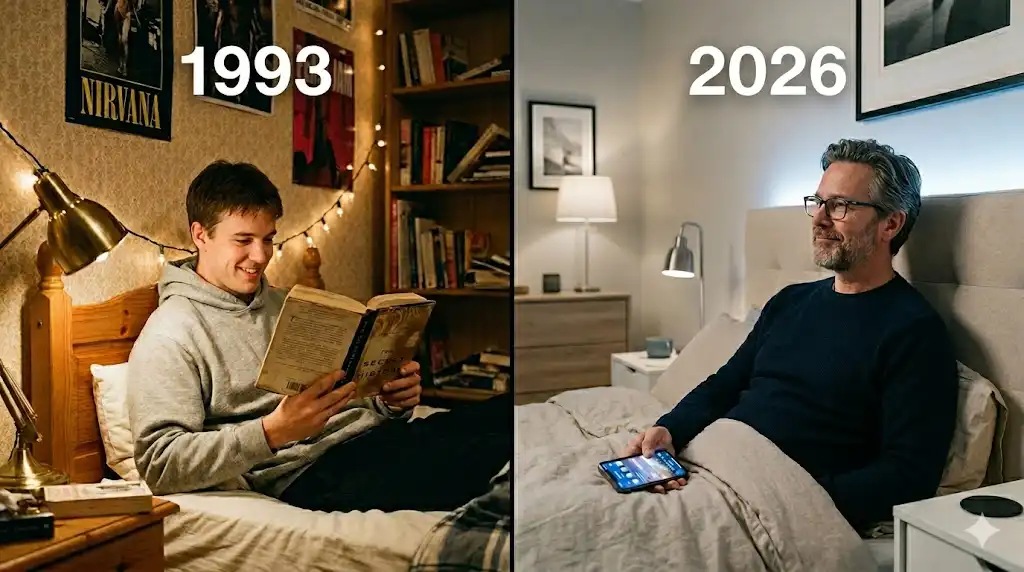
In 1993, when I was 19 years old, I thought that reading a book before going to bed was a fairly frictionless activity. You may not believe this, and I am quite embarrassed to say it, but I now consider the action of picking up a physical book and reading it before going to sleep as an activity with quite a lot of friction. The first element of friction is the choice to read at all. Why bother when I can just watch some reels on Instagram? But if I decide not to take my phone into the bedroom with me, I have won the first battle. The next element of friction is setting up the lighting in such a way as to be able to read the small print in the physical book. I have a reading light that I can clip onto the cover of a book and this needs to be angled in such a way that it shines directly onto the page. The final element of friction is – most embarrassingly – the fact that my brain has been so dramatically rewired by long-term overexposure to instant dopamine, that it takes me a couple of minutes to redirect my focus to the meaning of the words on the page. Sometimes I read the same sentence several times before I click into focus.
I need to face this reality unflinchingly. To flinch is to move involuntarily in pre-emptive shock. To be unflinching is to choose not to move and face reality. For me, enforced slowness is the decision to deliberately choose to do activities that have some friction. And if an activity with a useful end result seems undesirable, I try to pause for a moment and unpack mentally why that is.
I started this muse on creeping normality and frictionless distraction with an anecdote about how anger on a random Saturday morning became a watershed that led me to the catalyst of change. I want to finish by bringing that anger back into the centre of my thinking. I have said that ‘I need to remember and embrace how boring things sometimes were before the frictionless distraction of 2026, so that I can bring the idea of enforced slowness into my life now’ and become resilient again.
First, I recognise that, alongside all the good, useful and praiseworthy digital tools, there has been a concomitant rise in the digital dross and junk, and that much more time, energy and money has been poured into making me addicted to those useless and harmful things than has been dedicated to encouraging me to harness the good and useful digital tools. I say this first, because it helps me to deal with the sense of shame that I identified earlier. Shame and the remorse that it produces really have never helped me to be resilient about saying ‘no’ to digital distraction. Understanding that extraordinary efforts from teams of the most technically brilliant minds of our age have been supercharged by AI, with recursive self-improvement learning, to make me addicted to harmful things, helps me to be a little more gentle with myself. I’m not absolving myself of responsibility, but I am saying that I do choose not to direct my energy towards shame or remorse. These emotions have very little power in helping me to change or develop unflinching resolve.
Then, once I have consciously released shame and remorse, I have more energy to focus on the one emotion that has really helped me develop the resilience to say ‘no’. It is anger. I am happy to be quoted on this: anger, in the right context and directed towards the right things, is a beautiful and precious thing. Have you ever heard the word ‘anger’ described as ‘beautiful’ or ‘precious’? Perhaps not, but that is how I see it in this context. Anger is the emotion that I have chosen to keep as my companion after my epiphany on that Saturday morning in bed, but it is very carefully channelled anger. I am angry that many people have chosen to dedicate their careers to producing and promoting material that has been designed to rot people’s brains and ruin their lives. I am angry that legislators have – until recently – chosen not to challenge the social media machines. I am angry that I have allowed myself to be boiled alive slowly and I’m angry that the manipulative functions of social media apps use my own weaknesses against me. I’m angry about the time that I have lost, especially over the last decade and I’m angry that I have permitted myself to be enslaved by going back to this content. I define and hone this anger by speaking these things aloud and discussing them with other people. I nurture it and protect it. Yes, I nurture and protect this anger. Why? Isn’t it harmful to hold on to anger? In many cases yes, but in this case, definitely not.
I take all that anger about all those things and focus it, like a laser, on the screen of my phone at 11pm on a Saturday night. I allow myself to think about all the things that I have regretted about the hold that social media has had over me. And as I allow myself to feel the anger – fully cognisant about what it is and why I feel it – something miraculous happens. I am able to switch my phone off, go to bed, pick up a real book and start reading. It is the beautiful and precious superpower of anger, directed at the right target at the right time, that gives me the power to say ‘no’ to frictionless distraction and ‘yes’ to the friction of enforced slowness.
Be angry. Be very angry – but be angry at the right things. If you are, then it can become your superpower, too.
|
Focus Keyphrase C2 English Masterclass: Creeping Normality and Frictionless Distraction |
|---|
|
SEO title: (60 characters including space bars) C2 English Proficiency Lesson on digital junk vs. enforced slowness | Linguacade |
|
SEO description: (160 characters maximum) Explore the philosophy of the ‘attention economy’ and ‘creeping normality’ in this C2 Proficiency lesson. Learn to use sophisticated English to discuss digital addiction and resilience. |
|
Episode show notes (700 characters maximum) In this C2 Proficiency Masterclass, we move beyond basic conversation to explore the psychological and ethical complexities of our digital lives. We examine the ‘creeping normality’ of social media; the slow, stealthy process by which harmful habits become our ‘default’ reality. The episode explores the concept of ‘frictionless distraction’, looking at how infinite scroll and AI algorithms are designed to exploit human weakness. We also discuss the ‘boiling frog’ apologue and why a sense of enforced slowness is necessary to regain our agency in an age of instant dopamine. |
|
Excerpt (300 characters maximum) Are you a slave to frictionless distraction? In this C2 Masterclass, we unpack the creeping normality of the digital age. From the ‘crux of the problem’ to the ‘superpower of anger’, learn the sophisticated English required to discuss technology, ethics, and the fight to reclaim our focus. |
Join the Linguacade Patreon community to unlock full transcripts and audio for all levels (£4/month for total access)