
Hello! How are you? This is Jason. I’m happy to be with you today. How are you doing? I’m doing fine! It’s nice to work with you again.
Today we are going to study the alphabet in English. This is the long form.
Today we’re going to study the alphabet in English. This is the short form.
Today we’re gonna study the alphabet in English. This is the very short form. It is also very informal.
‘We’re gonna’ is the same as ‘we are going to’ and ‘we’re going to’. It’s not good-quality English, but I’m teaching it because it is what people often say. If people often say certain words, then these words are called high-frequency words. ‘Gonna’ is a high-frequency word.
What is the alphabet? The English alphabet has 26 (twenty-six) letters. There are 21 (twenty-one) consonants and five vowels in the alphabet.
Listen to the letters of the alphabet and repeat them after me:
Aa, Bb, Cc, Dd, Ee, Ff, Gg, Hh, Ii, Jj, Kk, Ll, Mm, Nn, Oo, Pp, Qq, Rr, Ss, Tt, Uu, Vv, Ww, Xx, Yy, Zz
In American English, people say ‘zee’ instead of ‘zed’ (Zz).
Each letter has two forms. The big letters at the start of a sentence or phrase are called capital letters and the small letters are called lower-case letters.
There are 5 vowels in the alphabet. They are: Aa, Ee, Ii, Oo, and Uu.
In English, we use the verb ‘to spell’ to say the letters in words and names, in the correct order. Listen to these conversations:
Hello, I am Jason. Jason is spelled J-A-S-O-N. This is the long form.
Hi, I’m Jason. It’s spelt J-A-S-O-N. This is the short form.
Listen to these phrases. They all have the same meaning. They all mean the same thing:
My name is Jason. It is spelled J-A-S-O-N. My surname is Garner. It is spelled G-A-R-N-E-R.
My first name is Jason. It’s spelt J-A-S-O-N. My last name is Garner. It’s spelt G-A-R-N-E-R.
My name’s Jason and it’s spelt J-A-S-O-N. My family name’s Garner and it’s spelt G-A-R-N-E-R.
Your ‘name’ can also be your ‘first name’. They are the same thing. Your ‘surname’ can also be your ‘last name’ or your ‘family name’. They are the same thing.
In English, a person may use long sentences or short sentences to introduce themselves and say their name. Listen to these sentences. The first sentences are long and the last sentences are short:
My first name is Tom and my surname is Smith. This is the long form.
My name’s Tom and my surname’s Smith. This is the short form because ‘my name’s’ means ‘my name is’.
My name’s Tom and my family name’s Smith.
My name’s Tom and my last name’s Smith.
All of these sentences are good and correct.
Now listen to this long-form conversation:
Hello! What is your name?
My name is Tom.
How do you spell Tom?
It is spelled T-O-M.
And what is your surname?
My surname is Smith.
How do you spell Smith?
It is spelled S-M-I-T-H.
Now listen to this short-form conversation. It means the same as the previous conversation, but it is shorter. English people normally use the short forms when they speak:
Hi! What’s your name?
My name’s Tom.
How do you spell Tom?
It’s spelt T-O-M.
And what’s your last name?
My last name’s Smith.
How do you spell Smith?
It’s spelt S-M-I-T-H.
Now listen to this conversation:
My name’s David Rogers and I live in Birmingham.
Can you spell David, please?
Sure, it’s D-A-V-I-D.
And can you spell Rogers, please?
Certainly. It’s R-O-G-E-R-S.
I’m sorry, can you repeat that please?
No problem. It’s R-O-G-E-R-S.
Thanks, I got it that time.
Do you live in Bristol, David?
No, I’m from Birmingham and I live there.
How do you spell Birmingham?
It’s spelt B-I-R-M-I-N-G-H-A-M.
I didn’t understand that. Could you repeat it please?
Okay. No worries! It’s B-I-R-M-I-N-G-H-A-M.
If you want to know how to spell a word or a name you must ask a question. Here are some questions that you can ask:
Could you spell that for me please?
Can you spell that please?
How do you spell that?
How do you spell it?
How’s that spelt?
How’s it spelt?
You can see that there are many ways to ask the same question because these questions all mean the same thing. If something ‘means the same thing’ it is not different. It is the same.
Now listen to these phrases:
I’m sorry, I didn’t understand that. Could you repeat it, please?
I’m sorry, could you repeat that for me, please?
Sorry, can you repeat that, please?
Can you repeat that?
You can see that there are also many ways to ask someone to repeat something again.
***
Now we’re going to look at the days in the week.
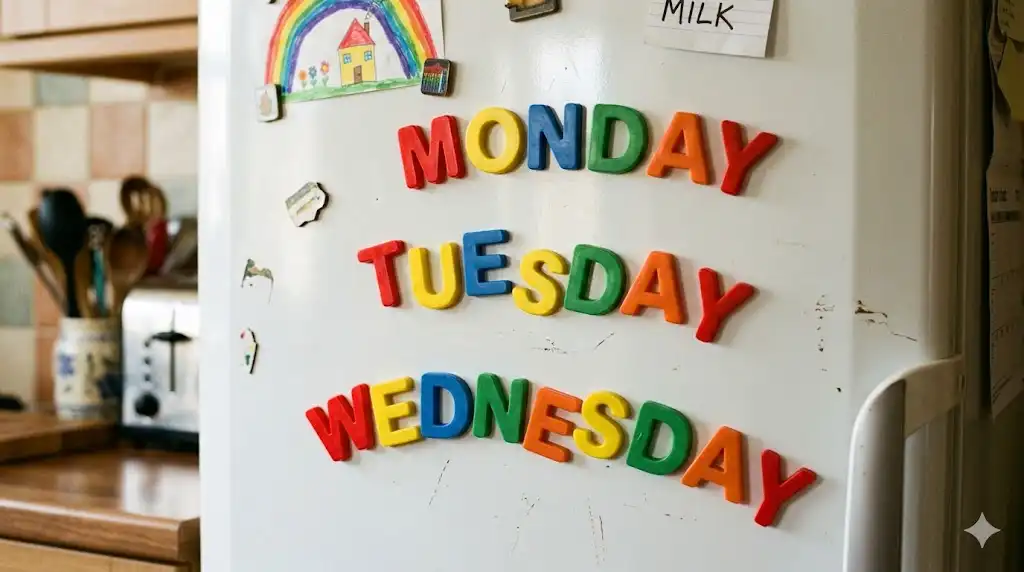
There are 7 days in a week. A day is a period of 24 (twenty-four) hours. Listen to the days and say them after me:
Monday, Tuesday, Wednesday, Thursday, Friday, Saturday, Sunday.
Can you see that the days all start with a capital letter? This is important. When you write the days, you must write them with a capital letter. Remember that a capital letter is a big letter and a lower-case letter is a small letter.
Monday is the first day of the week. The ‘first day’ means ‘day number one’.
Tuesday is the second day of the week. The ‘second day’ means ‘day number two’.
Wednesday is the third day of the week. The ‘third day’ means ‘day number three’.
Thursday is the fourth day of the week. The ‘fourth day’ means ‘day number four’.
Friday is the fifth day of the week. The ‘fifth day’ means ‘day number five’.
Saturday is the sixth day of the week. The ‘sixth day’ means ‘day number six’.
Sunday is the seventh day of the week. The ‘seventh day’ means ‘day number seven’.
Now listen to these phrases:
What is the first day of the week?
The first day of the week is Monday.
What does ‘first’ mean?
‘First’ means ‘number one’.
How do you spell Monday?
It’s spelt M-O-N-D-A-Y
What’s the fifth day of the week?
The fifth day of the week is Friday
What does ‘fifth’ mean?
‘Fifth’ means ‘number five’.
How do you spell Friday?
It’s spelt F-R-I-D-A-Y
Saturday is the sixth day of the week and Sunday is the seventh day of the week. The two days Saturday and Sunday are called the weekend.
To finish this lesson, let’s look at the verb ‘to mean’. It’s very important for asking questions and clarifying in English. ‘Clarifying’ means ‘checking’.
Listen to these phrases:
What does ‘Tuesday’ mean?
Tuesday is the second day of the week.
What does ‘gonna’ mean?
‘Gonna’ means ‘going to’. It’s a very short form. It’s very informal.
I’m going to study on Monday.
What do you mean?
I mean that I’m going to read and listen to podcasts.
In English you must say, ‘What does … mean?’ (… = dot, dot, dot) You must not say ‘What means…?’ (… = dot, dot, dot) This is wrong. Please don’t say ‘What means…?’ (… = dot, dot, dot) . It’s not good English.
Listen to this incorrect, wrong and bad phrase:
‘What means ‘Monday’?’
No! This is wrong. It is bad English. You must not say ‘What means…?’ (… = dot, dot, dot).
Now listen to this correct, right and good phrase:
What does ‘Monday’ mean?
Yes! This is right. It is good English. You must say ‘What does … mean? (… = dot, dot, dot).
Let’s finish with several phrases that contain the correct, right and good structure:
What does ‘Saturday’ mean?
Saturday is the sixth day, but it is the first day of the weekend.
What does ‘phrase’ mean?
A phrase is a sentence.
What does ‘vowel’ mean?
A vowel is one of these letters: Aa, Ee, Ii, Oo or Uu.
This is the end of the lesson. Thank you for listening. Please go to linguacade.com to get the free transcripts for all my lessons.
Unlock the Deep Dive: If you enjoyed this lesson, join the Linguacade Patreon for just £4/month. Get instant access to exclusive masterclasses covering every highlighted word and phrase in the Beginner, Intermediate, and Advanced episodes.