
In recent weeks, I’ve had a strange and impossible sum floating around in my head: 26 + 26 = 2026. Obviously, it’s not correct. Firstly, 26 + 26 = 52. Secondly, you can’t add two cardinal numbers together and then express them as the year ‘2026’. Please bear with me while I explain what these numbers mean and why they are so momentous for me. I was born in the year 1974. Between 1974 and 2000 there were 26 years. Between 2000 and 2026 there have been 26 years. So, there’s a kind of equilibrium – a state of supreme balance, if you will – in my life right now. At the time of writing this content, I’m 52 years old. I had exactly half of those years before the millennium and I’ve had the other half since.
When I became aware of this symmetry of numbers in my life, I felt something akin to a sense of urgency. I wanted very badly to communicate both about what it feels like in 2026 to be Generation X (or, in short, a Gen Xer) and what it felt like before the millennium. I know what it was like to be around in the quieter times before the tech revolution and I also know what it’s like to be fully immersed in the cynical attention economy where uncontrolled algorithms run riot and people live in a semi-permanent state of panic borne out of endless, unavoidable comparison with those digital influencers who curate and publicise the veneer of a perfect life.
There was a particular event in the year 2000 that gives real kudos to this symmetry of numbers in my life. It was in March 2000 that Mark Bush, from Essex, became the first person in the United Kingdom to have a broadband internet connection installed in his home. Now, you could argue that the tech revolution started long before the introduction of broadband internet but, from my perspective, it was the rollout of broadband from 2000 onwards that created the instant availability of information and the immediacy of connection with a global community that our brains love and hate in equal measure. I believe that 2000 was a watershed year. Before I got broadband, my only access to the World Wide Web was via a 56k dial-up connection that allowed me to download – at the very most – 50 kilobits of data per second (50 kbps). If I wanted to download a single 4-minute song from the internet it took more than ten minutes. And, even then, it was usually at the standard bitrate of 128 kilobits per second. What I’m trying to say is that, in the era of dial-up internet connections, things were very slow indeed. It took a long time to load the homepage of a newspaper and it took even longer to send an email with an attachment.
When I reflect on the privilege of being a Gen Xer, it is because I conflate the word ‘privilege’ with the word ‘slowness’. I use the word ‘conflate’ deliberately. To conflate things means to combine two or more ideas or concepts into one, often mistakenly. In this connection it seems totally mistaken and counterintuitive to say that privilege somehow equates to slowness. Surely privilege is all about priority? It’s instant access, speed of entitlement, being first in line and suchlike. And yet, here I am saying that the privilege of being a Gen Xer is connected to the idea of slowness. But not slowness by choice; slowness by design. Slowness was imposed on us by the reality in which we lived. In the 1970s and 1980s there was much less choice. Things could only happen at a particular speed because the digital infrastructure did not exist to enable swift access. By way of example, John Hughes’s seminal teen movie The Breakfast Club was released in 1985 but I had to wait six years before it had its TV premiere. My cousin told me that it was going to be aired at 9pm on a Sunday night in 1991. I set a timer recording on the family’s Betamax video cassette recorder and went to bed. The following day I had my own copy, but it had been a very long time coming.
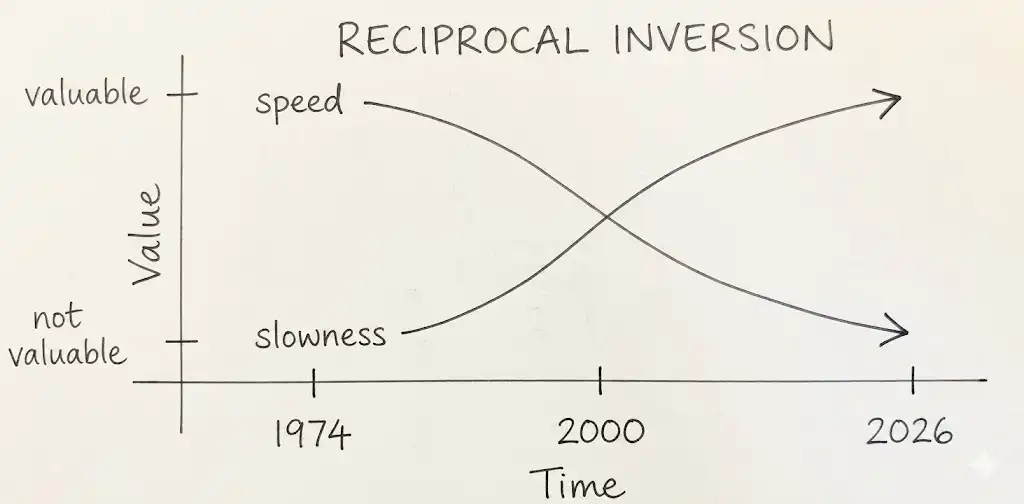
Before I go any further down a road of exploring and celebrating slowness I want to make my intentions clear and explain exactly where I am taking this. I don’t want to romanticise or misremember anything about my childhood. I want to be brutally honest and objective about the frustration of having to wait for things that were, quite often, inaccessible in the moment. Believe me when I say that, as a child of the 80s, I was often incredibly frustrated about how inaccessible certain things were to me with my limited financial means and a lack of free digital infrastructure. What I do want to do, however, is fully accept the fact that – if I choose to stand back from my reality and observe it impassively and objectively – I have experienced an extraordinary reciprocal inversion in my 52 years of life. But what is a ‘reciprocal inversion’? I shall try to explain. When I was growing up, imposed and unavoidable slowness was considered bad; we didn’t want it. Now, in 2026, voluntary and deliberate slowness is very often seen as the pinnacle of a good and mindful life. By the same token, when I was growing up, speed and accessibility were eminently desirable; we wanted things fast. Now, in 2026, speed and accessibility in the digital sphere are often considered unhelpful, and even dangerous, for us. Because we can have things quickly and easily, with minimal friction, we don’t value them as we might if they were less available. Put simply, what we had back then we did not necessarily want. Now that we have what we thought we wanted, we realise that we don’t necessarily want it at all and – in some cases – we wish that we could once again live under the imposition of not having the choice.
The more I reflect on this, the more I realise how very great a privilege it is to have been born in a year that placed me in this ‘sweet spot’ with 26 years of life on either side of the broadband revolution. I want to think actively, constructively and wisely about how I can live my life now in a way that remembers the past for what it truly was, without deceiving myself about how difficult and laborious it sometimes felt. I want to think honestly about how I can pull past memories of imposed inaccessibility into my present reality and recognise their value now in helping me to make good choices today.
In my young life it was the imposition of slowness, inaccessibility or the lack of finances that first frustrated me and then – due to sheer boredom – pushed me to make choices to start activities that triggered slow dopamine and led to good outcomes. Now, in my middle-aged life, it is the fearful memory of an evening wasted on the instant dopamine hit of frictionless distraction from the infinite scroll of social media reels that I try – often unsuccessfully – to harness in order to make choices to start activities that will trigger slow dopamine and lead to good outcomes. In the past, the lack of choice motivated me to choose the right path. Now, it is the ubiquity of choice that prevents me from choosing the right path.
How is this a ‘privilege’ or even a good thing? Wouldn’t it have been better for me never to have known what it was like to exist in a world where there was significantly reduced temptation to waste time? Well, yes and no. Living in that time enabled me to see that, due to circumstances beyond my control, I was forced to be considerably more patient and resilient than I am now. Although I’m embarrassed to say it, I must admit that I was, in some ways, a more focused and resilient person when I was 19 years old than I am now, at the age of 52. It is the symmetry of numbers in my life that enables me to see this in such clarity when it might not be so clear for someone born at a different time.
I used the collocation ‘sweet spot’ to describe this time frame in which I have been alive. The sweet spot of a tennis racket is the spot in the centre that will give maximum power and return from a ball strike. Likewise, I exist in a sweet spot of experience. My grandparents, who were born in the Silent Generation, had no access to information technology. My parents, who are Baby Boomers, belong to a generation that has only had access to unlimited information at the end of their life. Most of the Baby Boomers I know struggle with technology or have lived long enough without it not to be affected by its pervasiveness. Millennials (or Gen Yers) have some understanding of what it was like to live in a world untroubled by social media, but even those born in 1981 would probably have had access to email by the time they were 15. Finally, Gen Z and Gen Alpha never knew a world without the internet. They are true digital natives.
I am happy and grateful to sit in the sweet spot of these generational realities and be a true digital immigrant. I can remember the point in my life (at Cardiff University, in 1994) when writing emails took over from writing physical letters by hand, and I can remember when I had my first dial-up internet connection installed at my flat in Helsinki, Finland, in 1998. I can recall exactly how, when and why it became easier and more practical for me to use digital tools, rather than physical tools, for many of my day-to-day logistical tasks. But – and here I come to the crux of the problem – I can’t always recall how, when or why the concomitant, unhelpful digital distractions invaded my life. I have one particular memory of the moment when a family member persuaded me to join Facebook in 2007 but, apart from that, I don’t have any recollection of specific moments when I knowingly invited social media, short-form videos or online games to take up so much of my time. I am convinced that the reason for this is because the decisions to use digital tools for productivity were conscious but the decisions to allow myself to be distracted by social media were largely unconscious. Digital distractions are a creeping normality that has developed slowly and steadily over time. I didn’t invite them and I didn’t really want them. In fact, when I was using them, I tried actively not to think about the time that I was wasting. Denial prevented me from seeing the exponential increase in the time that I was throwing away.
Allow me to return to this word ‘privilege’ again. I have said it is a privilege to be a Gen Xer and to have been actively involved in this digital revolution because it enables me to see the ‘before’ and the ‘after’. If I can have the courage and honesty to recall and accept both the benefits and difficulties of living in a pre-digital age then perhaps I can choose now to rekindle a level of personal discipline that would enable me to see, with a revitalised sense of surprise, the potential of the amazing digital tools that could help me to achieve so much more than I do currently. Perhaps seeing things with fresh eyes would also give me the motivation and strength to sidestep the unhelpful and destructive side of digital distractions. I can vaguely remember a time when the pedestrians I passed in the street were alert and aware of their surroundings. If the 19 year-old me were suddenly transplanted from 1993 to 2026, I think he would believe that people had collectively lost their mind, being willing to risk death by keeping their eyes fixed on a miniature screen, even when crossing the road in busy traffic.
If I am truly to reawaken that sense of surprise and wonder I need to return to the past and remember some of the skills I wanted to acquire, which were sometimes so difficult to learn without computers or the internet. I must look unflinchingly at what was and what is in my own life so that I can take the good from the past and leverage it to discard the bad from the present. I must carefully and truthfully recall examples of what it was like so that I won’t distort the reality of what was not easy and then simply present the lazy cliché that everything was better because we didn’t have so many distractions.
I’ll focus on two skills: learning jazz piano and picking up new languages.
I tried to teach myself some jazz piano in my teenage years, but it was difficult. I didn’t have the money to pay for personal lessons so the only way to learn was to get teaching books from my local library. As I recall, the library did not have many books on jazz piano. The one book that I managed to get taught a system that did not sit well with my personal learning style. Whilst struggling through the book, I tried to listen to jazz, but it was hard to get hold of recordings. I had a cassette of the saxophonist Charlie Parker’s music but it was difficult to rewind and play his bebop licks without damaging the tape. Anyone who remembers cassettes will be all too familiar with how fragile they were and how easy it was to damage or destroy the magnetic tape by overplaying or by rewinding and playing the same section over and over again. I look back now and think of how limited my resources were and how so many doors to understanding jazz harmony were closed to me because the resources I needed were simply unavailable to me. If I compare that to my present-day reality, there are hundreds of free online courses teaching jazz piano to cater to every conceivable learning style. If I wanted to, I could simply visit YouTube for access to a complete set of graded video lessons that would lead me through every stage of learning from beginner to expert. It’s likely that between Spotify and YouTube, the entire back catalogue of every famous jazz pianist is instantly available for free. If my teenage self could see those resources, he would be amazed and he would most likely seize the opportunity to learn.
Likewise, when I was first studying Spanish and Finnish, the only resources I had were ‘Teach Yourself’ books and an analogue radio that could pick up weak signals of national stations in those languages. It was frustrating trying to tune the radio manually; the speech was difficult to understand due to the signal interference and the broadcasts were clearly meant for native speakers, not students. Many of the programmes I listened to were utterly boring – certainly not the kind of content that I would choose to listen to now. There were no transcripts or subtitles and I could not pause the broadcasts. It wasn’t until 2001 that I got a DVD player and was able to choose manually the audio language and subtitles for a movie. It’s difficult to describe how mind blowing that was. As for the ‘Teach Yourself’ books, they were presented in such a way that the introductory chapters were dedicated to page after page of explanations on how to pronounce words. But, without any audio, it was almost impossible to learn the correct pronunciations. In my first year of university, I had one hour of Spanish conversation class a week, but even that was as part of a group of four students, so the actual experience of hearing and speaking Spanish was greatly reduced. It’s good for me to think back and reflect on those obstacles to learning and how I tried to overcome them. Now, if I want to learn a new language, there are limitless volumes of resources teaching every kind of content I could imagine. I can listen to the news in slow Swedish whilst reading the transcript of what I’m hearing. I can right click any word or phrase and instantly get the translation. I can use AI to create for me bespoke resources containing explanations and exercises on any grammar or vocabulary that I can think of. I can converse with AI on any subject and I can ask it to change its accent, diction and speed to suit my ability. I can listen to excellent podcasts recorded in beautiful quality and tailored to every level of learning and experience. All of these things are at my fingertips 24/7, yet I often fail to capitalise on them because I’m too tempted by frictionless distraction. My mind is so dizzy with the multiple contexts presented by the deluge of short-form videos I consume that I no longer have the resilience or the memory of slow dopamine joy to help me say ‘no’. I need to remember how hard it was to learn new skills and then leverage that memory to be more disciplined and determined now.
There is one more thing that really needs to be said about those times before the internet: boredom was a big thing and not everyone used the feeling of boredom as a catalyst to motivate themselves to do something genuinely useful with their time. If you’ve seen a short-form video or reel that reminisces about how great the 80s were by showing a carefully-edited montage of clips from all the most iconic movies of the time, you might think that kids had immediate access to all those movies and could watch them whenever they wanted. The fast-paced editing of the reel that remembers the 1980s does not tell you that most young people did not even have a video cassette recorder, so they wouldn’t have been able to watch any of those movies on demand. For some reason, most of these reels are accompanied by the 1985 song, Live to Tell by Madonna. If Gen X teenagers wanted to listen to that song, they would have had to go to a record shop and buy the album or cassette of True Blue, which cost the equivalent of two hours-worth of work on the minimum wage. Waiting for things to become available engendered boredom and it was not fun. Not everyone had the patience to pick up a physical book and start reading. But – and here’s where I want to land – even if boredom didn’t make every Gen X teenager more productive, it had the capacity to create expectation and connection. Earlier, I mentioned the 1985 movie The Breakfast Club. It tells the linear story of five teenagers who find themselves stuck in detention together on a Saturday in a school library in a fictional suburb of Chicago, Illinois. At first, they largely ignore each other. Then they are hostile and quarrelsome. Eventually they start talking and, well… the rest is teen movie history. The point here is that, without digital distractions, the teenagers got so very bored that there was literally nothing else for them to do except connect and communicate with each other. I can’t help but wonder how it would have been if they had each had a mobile phone with them. They could all have retreated into their own corner for the day and ignored the others completely. There would be no enforced boredom or connection, therefore there would be no story and no movie.
I would like this content to be a manifesto to myself. These days, I have to choose slowness consciously and intentionally. When I sit down to start something productive and boot up the laptop I have to ask myself, at every moment, is the digital content I’m about to access something that will help lead me from A to B, or is it something that will distract me? Would I actually be more productive if I didn’t have the digital tools or distractions; if I was back in the 1980s with just a pen and an exercise book to write in? Of course, I want the best of both worlds: the access to all the great tools and information and the self-discipline not to be distracted. So, I need to bring the 19 year-old version of myself into the present day and allow myself to be amazed and excited by the extraordinary potential that the tech revolution still has to offer. I need to remember and embrace how boring things sometimes were before the frictionless distraction of 2026, so that I can bring the idea of enforced slowness into my life now and become that resilient 19 year old again. And even if I don’t always use enforced slowness to make myself more productive, I can at least put my mobile phone away in public and connect with people, even if that means simply acknowledging them in the street and saying, ‘Hello’. Perhaps I should watch The Breakfast Club again.
Unlock the Deep Dive: If you enjoyed this lesson, join the Linguacade Patreon for just £4/month. Get instant access to exclusive masterclasses covering every highlighted word and phrase in the Beginner, Intermediate, and Advanced episodes.