
I want to share with you a rather strange fact about learning numbers. In order to understand this strange fact, you will need to know a little about the CEFR. Have you heard of the CEFR? Well, ‘CEFR’ is the acronym for the Common European Framework of Reference for Languages. It was created in the 1970s to standardise language learning in Europe. In other words, the CEFR created standard levels that could be used and applied to all European languages. Later, it was extended as a global standard to define common levels for all world languages. The reason for creating these levels was to give all people in Europe a way to measure ability and proficiency in different languages. You may know these levels, but I will outline them here in case you do not. A1 is called ‘Beginner’, A2 is called ‘Elementary’, B1 is called ‘Intermediate’, B2 is called ‘Upper Intermediate’, C1 is called ‘Advanced’ and C2 is called ‘Proficiency’.
Now, here is the strange thing about the CEFR and learning numbers in a language. According to the CEFR, an A1 Beginner should know (or at least recognise) the cardinal and ordinal numbers from 1 to 100. In case you didn’t know, the cardinal numbers are: 1 (one), 2 (two), 3 (three), 4 (four), and so on; and the ordinal numbers are: 1st (first), 2nd (second), 3rd (third), 4th (fourth), and so on. However, many of the students I have taught at much higher levels than A1 did not know them well. In some cases, I have had students in my English classes who were generally at B2 or C1 level but they did not know how to express or write cardinal or ordinal numbers. Isn’t that strange?
If a student of English is Advanced in most language skills but at Elementary or even Beginner level with numbers, we would call this a huge contradiction. But why does this contradiction exist?
So, I think there are two answers to that question.
The first answer is, of course, that the CEFR levels are ‘not an exact science’ and that a student may have achieved an overall level in a language, but that level ‘does not tell the whole story’ of the student’s ability. In other words, a student who has achieved a certain CEFR level overall is not necessarily always functioning at that level in all four skills. Therefore, if a person says, ‘I’m C1 in English’ it probably means that they generally operate at C1 level – and they may even have an exam result as evidence – but their true ability in the four skills could be different. Perhaps they are B1 in Reading, B2 in Writing, C1 in Speaking and C2 in Listening. A ‘level’ is nothing more than an indicator of a general reality. Every person is unique and C1 means something different for every single student of English. What I am trying to say here is that the levels are not an objective measure of a person’s true ability. The levels are subjective.
The second answer to the question relates to how difficult numbers are in different languages. Even though the CEFR states that an A1 Beginner student should know (or have a general understanding of) the cardinal and ordinal numbers from 1 to 100, there is a very great difference between the difficulty of learning these numbers in, for example, Spanish and Finnish. The ordinal numbers in Spanish are relatively easy but ridiculously difficult in Finnish. And, even though the Spanish ordinal numbers are not that difficult to master, I must admit that I can’t always remember all of the rules for them.
So, here are the two key takeaways from this first part of the episode. Firstly, you can have a good level of English and still not be an expert in a relatively basic aspect of the language; this is okay and it’s normal. Secondly, learning and expressing numbers correctly is a tricky thing in every language; that’s also okay and normal.
***
In this part of the lesson, I would like to focus on a few very simple rules that will enable you to use cardinal numbers correctly. I strongly recommend that you go to linguacade.com so that you can follow the free transcript while you listen. If you follow the transcript, then you will be able to see the numbers that I say. I always find it very helpful to see the language that I hear because it helps me to embed the learning much more quickly.
Without a doubt, the most important rule to learn when saying cardinal numbers is knowing where to use the word ‘and’. If you only learn one rule about expressing cardinal numbers in English, make it this one.
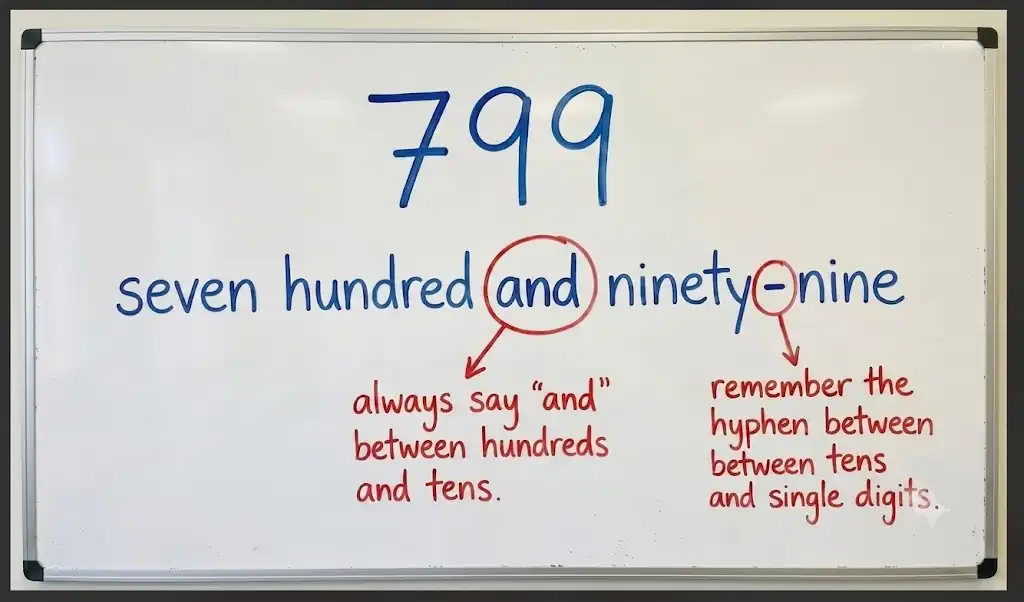
When you say a number in English, you must say ‘and’ between hundreds and tens, and between hundreds and single-digit numbers. Here are some examples:
425 (four hundred and twenty-five), 168 (one hundred and sixty-eight), 799 (seven hundred and ninety-nine), 232 (two hundred and thirty-two), 315 (three hundred and fifteen).
Even if there are no tens (or multiples of ten), you must still add the word ‘and’ before single digits. Here are some examples of this:
405 (four hundred and five), 108 (one hundred and eight), 709 (seven hundred and nine), 202 (two hundred and two), 305 (three hundred and five).
Additionally, if there are thousands but no hundreds, it is still essential to add the word ‘and’ before tens or single-digit numbers. Here are some examples:
1,005 (one thousand and five), 7,099 (seven thousand and ninety-nine), 2,002 (two thousand and two), 3,055 (three thousand and fifty-five).
In these examples, can you see that, in compound numbers of more than 100 (one hundred), the word ‘and’ is always required before tens and single-digit numbers?
In fact, it doesn’t matter how large the compound numbers are; the word ‘and’ is still required before tens and single digit numbers. Listen to these examples:
3,426,001 (three million, four hundred and twenty-six thousand, and one).
12,028 (twelve thousand and twenty-eight).
49,000,074 (forty-nine million and seventy-four).
In the simplest terms, it would be helpful for you to remember that you always need to say the word ‘and’ before tens or single-digit numbers. This is the case even when you say numbers in the hundreds of thousands. Listen to these examples:
397,203 (three hundred and ninety-seven thousand, two hundred and three).
100,423,001 (one hundred million, four hundred and twenty-three thousand and one).
To finish this section on when to use the word ‘and’, let’s look at some examples of when the word ‘and’ is not needed. Remember that we do not use the word ‘and’ if there are no tens or single digit numbers. Listen to these examples:
300,900 (three hundred thousand, nine hundred).
25,000,000 (twenty-five million).
10,500,300,100 (ten billion, five hundred million, three hundred thousand, one hundred).
1,000,000,000,000 (one trillion).
The United Kingdom and the United States use the short-scale system of number generation. This means that a million is a thousand thousand; a billion is a thousand million, a trillion is a thousand billion and a quadrillion is a thousand trillion, and therefore has 15 zeros. ‘Quadrillion’ is not a word that we use much in English, although you may hear it to describe distances in space or theoretical periods of time.
***
The next important rule is about pluralising. If you pluralise a word, you make it plural, usually by adding an -s on the end of the word. Now, many languages pluralise cardinal numbers but English does not. I don’t want to give many examples of incorrect uses of cardinal numbers, because it is not good or helpful even to hear incorrect phrases. However, it is important to remember that no cardinal numbers in English are pluralised. This means that you cannot add an -s to the words ten, hundred, thousand, million, billion or trillion when they are cardinal numbers. Therefore, you cannot say ‘five hundreds’ or ‘two thousands and three hundreds’. This is completely wrong.
There is, however, one situation in which you can pluralise these number words, and that is when they are used as indefinite nouns rather than cardinal numbers. Listen to the following examples. In the first phrase, the number is used as a cardinal number and it cannot be pluralised. In the second phrase, the number is used as an indefinite noun and it can be pluralised.
***
I counted 35 (thirty-five) cars that were parked in the field.
Here, 35 (thirty-five) is a cardinal number, so it is not pluralised. A person counted the exact number of cars in the field.
Tens of cars were parked in the field.
Here, the word ‘tens’ is being used as an indefinite noun to describe ‘twenty or more’. We do not know exactly how many cars were parked in the field. There could have been anywhere from 20 (twenty) to 200 (two hundred) cars.
***
Approximately 700 (seven hundred) people attended the demonstration in Paris.
Here, 700 (seven hundred) is a cardinal number, so it is not pluralised. We have a general idea of how many people attended the demonstration in Paris. It was more or less 700 (seven hundred).
Hundreds of people attended the demonstration in Paris.
Here, the word ‘hundreds’ is being used as an indefinite noun to describe ‘two hundred or more’. We do not have such a clear idea of how many people attended the demonstration in Paris. It could be anywhere from 200 (two hundred) to 2,000 (two thousand).
***
‘An indefinite noun’ is a noun that is not definite or exact. This means that the noun does not give a clear idea of the exact number. Here are the common number words that can be used as indefinite nouns:
Tens of… means anywhere between 20 (twenty) and 200 (two hundred).
Hundreds of… means anywhere between 200 (two hundred) and 2,000 (two thousand).
Thousands of… means anywhere between 2,000 (two thousand) and 2,000,000 (two million), although you can say ‘tens of thousands of…’ for any number between 20,000 (twenty thousand) and 200,000 (two hundred thousand), and ‘hundreds of thousands of…’ for any numbers greater than 200,000 (two hundred thousand).
Millions of… means anywhere between 2,000,000 (two million) and 2,000,000,000 (two billion).
Billions of… means anywhere between 2,000,000,000 (two billion) and 2,000,000,000,000 (two trillion).
Trillions of… means any number above 2,000,000,000,000 (two trillion). Usually, when people use the phrase ‘trillions of…’, it is used to describe astronomical numbers, such as the numbers of stars or galaxies in the known universe.
There are also a couple of other historical numbers that are sometimes used as indefinite nouns. These are the word ‘dozen’ (which means 12) and the word ‘score’ (which means 20). Now, these words are old-fashioned and they are not much used nowadays, but you may see or hear them sometimes in set contexts. The word ‘dozen’ is often used to describe numbers of food items. This is a set context. For example, you may hear someone say, ‘half a dozen eggs’ (meaning 6 eggs), ‘a dozen doughnuts’ (meaning 12 doughnuts) or ‘two dozen sausages’ (meaning 24 sausages). The word ‘score’ is only really used as an indefinite noun and it is certainly not used as much as ‘dozen’.
Listen to these examples:
Dozens of teenagers were waiting in line to buy tickets for the concert.
This means that several multiples of 12 teenagers were waiting in line. In reality, this is just another way of saying ‘tens of teenagers were waiting in line’.
Scores of people were leaving the school building when I arrived.
This means that several multiples of 20 people were leaving the school building. In reality, this is just another way of saying ‘tens of people were leaving the school building’.
Now, if I’m being pedantic, I would say that ‘scores of…’ communicates a higher number than ‘dozens of…’ simply because 20 is a higher number than 12. However, whether you say ‘tens of…’, ‘dozens of…’ or ‘scores of…’, these all communicate a number less than 200. If you have more than 200, then you should say, ‘hundreds of…’
Before we move on, let’s remember that if we use numbers as indefinite nouns, we generally use them with ‘of’ and a plural noun. For example, hundreds + of + plural noun. Here’s a final example to illustrate this:
First, I thought there were hundreds of people at the concert. Then, I realised that there were thousands.
Here, I could say ‘thousands of people’, but it is understood from the first sentence that I am referring to people, so I do not need to repeat the words ‘of people’.
To finish this rule on numbers used as indefinite nouns, I would like to mention other simpler ways of communicating indefinite numbers. Listen to these phrases:
There were approximately 20 people in the room.
There were more or less 20 people in the room.
There were about 20 people in the room.
There were 20-ish (twentyish) people in the room.
The words ‘approximately’, ‘more or less’ and ‘about’, followed by a number, are all adverbs of degree, which means ‘adverbs that communicate how much’. In this case, these adverbs all mean ‘somewhere close to that number’, so ‘approximately 20’ means ‘somewhere close to 20 – perhaps 18, 19, 20, 21 or 22 – I just can’t be sure’.
The word ‘ish’ is not an adverb of degree. It is a suffix, which means ‘a set of letters that are added to the end of the word to modify it.’ I just love the suffix ‘ish’. It’s informal and generally used in conversation, but it also means ‘something like that’ or ‘to some extent’. Theoretically, ‘ish’ is an approximate adjective. Listen to these examples with ‘ish’:
‘My friend is coming at 8-ish (eightish) tonight.’ Here, ‘eightish’ means ‘at around 8pm’.
‘I’d say 50-ish (fiftyish) people turned up to the party.’ Here, ‘fiftyish’ means ‘approximately fifty people’.
‘He had reddish brown shoes’. Here, ‘reddish’ means ‘somewhat red’ or ‘quite red’.
‘I was tired last night. Well, tired-ish.’ Here, ‘tired-ish’ means ‘somewhat tired’ or ‘quite tired’.
You can also use the word ‘ish’ on its own to communicate the idea of ‘quite’, ‘somewhat’, ‘sort of’. It’s highly informal but it’s a great way to communicate a lot with one short word. Listen to this example:
‘Are you angry with me?’
‘Ish.’ Here, ‘ish’ means ‘Yes, I am somewhat angry with you, but I am not very angry; I’m just sort of angry.’
‘Are you thirsty?’
‘Ish.’ Here, ‘ish’ means ‘Yes I am somewhat thirsty, but not very thirsty. I would be happy to have a drink, but I don’t need one.’
‘Ish’ is a really fun suffix in English. If you would like to know more about how to use it, please listen to the Deep Dive for this episode.
***
Another small rule worth mentioning is that it is possible to use the word ‘a’ instead of ‘one’ before hundred, thousand, million, billion and trillion, if you don’t want to emphasise the number. You can only use the word ‘a’ if you say the exact number. Listen to these examples:
There are more than one billion (1,000,000,000) people actively learning English in the world.
Here, ‘one billion’ is the normal, correct and standard way of saying the number.
There are more than a billion (1,000,000,000) people actively learning English in the world.
Here, I am using ‘a billion’ because I don’t particularly want to emphasise the word ‘billion’.
The general rule in English is that if you use more words, or if you make a phrase longer, it is because you want to emphasise something. If you use fewer words, or if you make a phrase shorter, it is because you don’t want to emphasise something.
***
The other small rules for cardinal numbers are more visible in writing so you will only be able to see how these work if you are reading the transcript at linguacade.com while listening to this episode.
The first little rule for writing numbers relates to the use of a ‘hyphen’. A hyphen is a little dash, which is a little horizontal line, that connects two words (-). When writing the long forms of cardinal numbers it is always necessary to place a hyphen between tens from 21 (twenty-one) and above, and single-digit numbers. ‘Single-digit’ numbers are the numbers between 1 and 9. If you look back at the written examples in this episode, you will see that every number from (21) twenty-one to (99) ninety-nine has a written hyphen between the tens and the single digits. Here are some examples:
58 (fifty-eight), 239 (two hundred and thirty-nine), 4,462,131 (four million, four hundred and sixty-two thousand, one hundred and thirty-one).
The second little rule relates to the use of ‘commas’ and ‘decimal points’. A comma is the little tick that separates words or numbers (,) and the ‘decimal point’ is the punctuation dot that is also used as a full stop or period (.).
First, let’s look at how the comma is used to separate numbers when they are written as numerals (the actual numbers) and when they are written as long-form words. When writing the numerals only, a comma is always placed in front of every three digits, so there is a comma before the thousands, before the millions, before the billions, before the trillions and so forth. Interestingly, a comma must also be used in the same place when writing out the long form of the number. Look at this example:
999,999,999,999 (nine hundred and ninety-nine billion, nine hundred and ninety-nine million, nine hundred and ninety-nine thousand, nine hundred and ninety-nine).
This is a great example because it contains nearly all the punctuation that a person would need when writing a number and it shows some of the key rules from this lesson. You can see that the commas split the numerals before the thousands, before the millions and before the billions. You can also see that the comma is used in exactly the same places for the long-form words. This example also has the word ‘and’ in the correct place and the written hyphen between the tens and single digits in ‘ninety-nine’.
Last, but not least (meaning that ‘this is the last thing, but it is not the least important’), it is important to mention the decimal point. The decimal point, which is usually called ‘point’, is the punctuation dot (.) that is also used as a full stop or period, but it has a different function in numbers. Listen to these examples.
25.5% (twenty-five point five percent) of people prefer dark chocolate.
I scored 9.8/10 (nine point eight out of ten) in my final exam.
The value of π (pi), rounded to four decimal places, is 3.1416 (three point one four one six).
There was a 0.6% (nought point six percent) or (zero point six percent) drop in GDP (Gross Domestic Product) this quarter.
In English, the decimal point is used to communicate a part of a whole number less than 1 (one). This is an important thing to mention, because if you want to communicate a part of a number less than 1 (one) when speaking, you actually need to say the word ‘point’. Now, some languages have their own different system of dividing numbers and, for this reason, students sometimes assume that their system works in English. This can cause confusion. For example, some other languages use a decimal point, instead of a comma, to separate large whole numbers and they use a comma, instead of a decimal point, to communicate a part of a number less than 1 (one). I have heard students say ‘one comma two five’ when they really intended to say 1.25 (one point two five). There are times when it could be quite important to get this right. As a general rule you never need to say the word ‘comma’ in numbers, even though it is written. However, you always need to say the word ‘point’. Here is a final example to demonstrate this:
The prospector found a gold nugget that weighed 1,372.5 (one thousand, three hundred and seventy-two point five) grams.
This is a good final example, because it contains a lot of the rules we have studied today.
Now, you may listen to this episode and think, ‘Wait a minute – Jason has certainly not covered all the important rules relating to numbers’. That is true. What I have tried to do here is focus on the highest-frequency mistakes that my students have made with cardinal numbers and then cover them in one lesson. My aim here has been to provide help for the main problems that students have when expressing numbers, not to provide rules for every possible situation relating to numbers.
If you would like to know more, particularly about ordinal numbers and numbers as adjectives then I encourage you to get the Deep Dive for this episode. Each Deep Dive provides a masterclass on the words highlighted in bold in the free episode and explores other related topics on a deeper level. If you subscribe to the Linguacade Deep Dives on Patreon you will get access to all Deep Dives for all levels (Beginner, Intermediate and Advanced). Subscribing to the Deep Dives is the best way to support my work as a creator generally. I absolutely love what I do and it is a huge encouragement to receive support for it.
If subscription is not for you, but you would still like to revise ordinal numbers, I recommend that you listen to the Beginner episode 3, entitled Age, birthdays, months and numbers 11-100. That episode contains the ordinal numbers from 1st (first) to 31st (thirty-first) because those ordinal numbers are vital for expressing dates, such as ‘29th December’ (the twenty-ninth of December). If the content in that Beginner episode is generally too easy for you, a useful hack is to listen to the lesson on the Linguacade website and speed up the audio to 1.5 (one point five) times normal speed. By the way, ‘a useful hack’ is a collocation that means ‘a helpful and quick solution’.
Finally, in my next Intermediate episode I will be looking at how to express years and the digit 0 (zero), given that these are absolutely vital for basic communication.
Thank you for joining me today on this journey through numbers. If I am being entirely honest, I must say that reviewing these rules has been useful and helpful for me, too!
Unlock the Deep Dive: If you enjoyed this lesson, join the Linguacade Patreon for just £4/month. Get instant access to exclusive masterclasses covering every highlighted word and phrase in the Beginner, Intermediate, and Advanced episodes.
Leave a Reply