
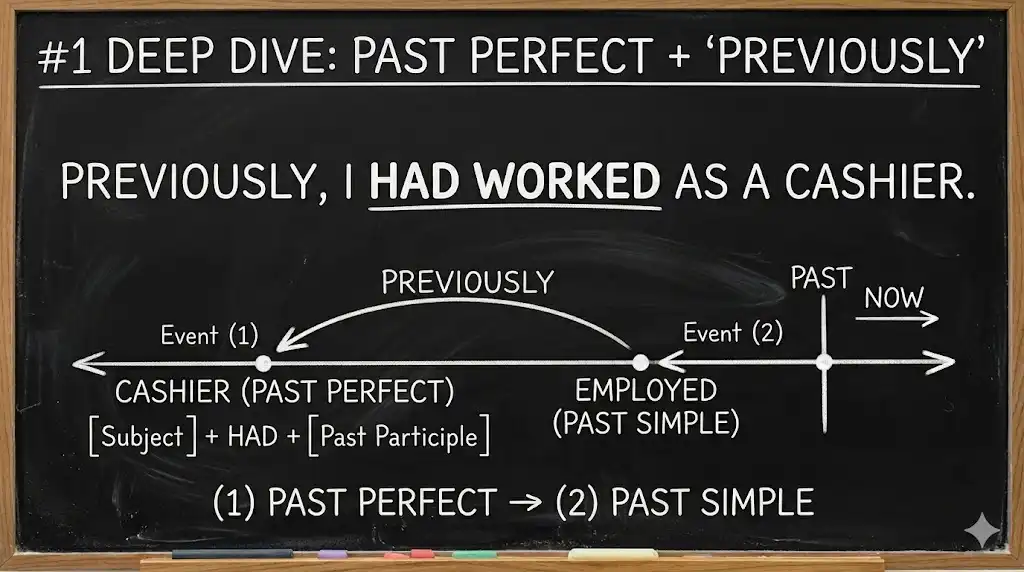
Welcome to this, the first intermediate Deep Dive from Linguacade. I’m excited about the grammar that we are going to explore today because many of my students find it difficult to understand exactly how to use the Past Perfect Tense, and I am sure that this session will help you develop confidence in using it.
I’m going to introduce two words today, and show you how they trigger the Past Perfect Tense in English. The verb ‘to trigger’ means ‘to make something happen’.
The two words ‘previously’ and ‘before’, both trigger the Past Perfect Tense. The words ‘previously’ and ‘before’ are interchangeable. This means that they mean the same thing, which is, ‘at a time before this moment’ or ‘at a time before that moment’. Let’s look first at ‘previously’ with this example from Intermediate episode 1 ‘Meet your teacher’:
‘The principal must have been pretty desperate because she chose to employ me as a part-time teacher of English anyway. Previously, I had worked as a cashier in a local shop and as a barman in a pub, so the opportunity to earn more money and do a more interesting job was quite a step up for me.’
This episode is telling a story; the story of Jason’s career. In English, when we tell a story and say what happened in the past we use the Past Simple Tense when we are describing events in the order in which they happened. Here’s an example:
‘In 1991, Jason worked as a cashier in a local shop. Then he changed jobs and became a barman. He did this until spring 1992. Then, in summer 1992, Jason’s mother asked her boss, the principal, to consider employing Jason at the language school. The principal was desperate so she decided to employ Jason. He accepted the job and he started working at the language school in summer 1992.’
These sentences tell a story in the Past Simple Tense. You will notice that the events in this version of the story happen one after the other, in the correct date order (which we describe as ‘chronological’ order). Because every event is in its correct place, in date and time order, we use the Past Simple Tense for every verb. This is a very important rule to understand in English grammar; if you tell a story and you list the events in the order that they happened, from the first event to the last event, then you should use only the Past Simple Tense. This is a little bit like saying, ‘First, second, third, finally.’
However, when we tell a story in the Past Simple Tense but we introduce an event that is out of sequence, because it happened before an event that has already been mentioned in the story, then we often use the word ‘previously’ followed by the Past Perfect Tense. This is a little bit like saying ‘Second, third, (previously) first, finally’.
Let’s examine how that works. First, let’s look at the correct, chronological order of the events:
(1) Jason worked as a cashier and then he worked as a barman
(2) The principal was desperate so she employed Jason
However, in my story, I change the sequence of the events:
(2) ‘The principal must have been pretty desperate because she chose to employ me as a part-time teacher of English anyway. (1) Previously, I had worked as a cashier in a local shop and as a barman in a pub, so the opportunity to earn more money and do a more interesting job was quite a step up for me.’
Here, I am providing information that is out of sequence because it happened before something else, so I use the word ‘previously’, which means ‘before that time’. Then I use the Past Perfect Tense. This is an easy tense to form, because it is made with the subject (I, you, he, she, it, we, they) plus the Past Simple form of ‘have’, which is ‘had’ and finally the past participle, which is often called ‘Verb 3’ because it is verb number 3 in a table of verbs.
Now, should you say ‘Previously I had worked’ or ‘Previously I’d worked’? Students often ask me when they should contract phrases and use the short form and my answer is very simple. When you don’t want to emphasise a phrase or a part of a sentence, then you should contract it and use the short form. When you do want to emphasise that part of the sentence, you should use the uncontracted long form. You might want to pronounce the contracted forms to check them.
I had = I’d, you had = you’d, he had = he’d, it had = it’d, we had = we’d, they had = they’d
Here are some more examples. Some of these are the contracted short forms and some of these are the uncontracted long forms:
‘In 2023, Harry Kane moved to Bayern Munich. Previously, he had played for Tottenham Hotspur.’ (The uncontracted long form ‘he had’ gives a little focus and emphasis to his previous job at Tottenham Hotspur).
‘Last year we went to Paris for the summer whereas previously, we’d always been to London.’ (The contracted short-form ‘we’d’ shows that this Past Perfect phrase is not a particular emphasis of the sentence).
Now let’s look at the Past Perfect used with ‘before’. Here’s our first phrase:
‘Before starting university, I had not studied Spanish.’
Let’s examine how that works by looking at the correct, chronological order of the events:
(1) Jason didn’t study Spanish.
(2) Jason went to university and started studying Spanish.
Here are two other examples from the episode:
‘The advanced group was made up of students who had studied Spanish at school…’
(1) Some students studied Spanish at school.
(2) Those students joined the advanced group at university.
‘…and the beginner group was made up of students who had never studied Spanish before.’
(1) Some students didn’t study Spanish.
(2) Those students joined the beginner group at university.
In all of these sentences the order of the events is not in sequence, so we must use the Past Perfect Tense to communicate that the second event mentioned actually happened before the first event.
Now, it would technically be possible to avoid using the Past Perfect Tense and, instead, to tell the story with the events in the correct order, using only the Past Simple Tense. Listen to how this would sound:
Some students studied Spanish at school and they made up the advanced group, but some students did not study Spanish at school and they made up the beginner group.
While this is technically possible, it does not sound good in English. In fact, it sounds forced, heavy and unnatural. The reason for this is because every activity in the sentence has equal importance. I don’t want every activity and event in the sentence to have equal importance. I want my listeners to know that what happened before university was a less important detail.
Let’s look again at how the sentence was phrased in the Intermediate podcast episode 1:
‘The advanced group was made up of students who had studied Spanish at school and the beginner group was made up of students who had never studied Spanish before.’
I have said that the Past Perfect Tense is used to refer to a past event that is not in the correct sequence, but there are two other important reasons for using the Past Perfect Tense in this kind of phrase.
The first reason is because the focus of the story is the experience at Cardiff University, not the experience that students had at school. I’m not so interested in what the students did at school and I don’t want to make it my focus in the sentence. I only want to refer back to what had happened before university to provide some context or extra information. If I avoid the Past Perfect Tense and only use the Past Simple Tense I must list the events in the order that they happened (first, second, third, finally). If I do this then school – not university – becomes the main focus of the sentence, thus:
‘Some students studied Spanish at school and they made up the advanced group, but some students did not study Spanish at school and they made up the beginner group.’
Can you hear that, in this heavy and unnatural sentence, the focus is on school, not university? I don’t want that, so the sentence in the story uses the Past Simple Tense for the important parts of the sentence and Past Perfect Tense for the details that had happened before, and which affected the composition of the two Spanish groups; beginner and advanced.
One easy way to understand how to use ‘previously’ and ‘before’ with the Past Perfect Tense is to imagine taking a photo. When you take a photo you choose the object that is the focus of your picture. You aim your camera at the image that is important to you, for example a person. This person is in the foreground, or the centre. However, there are usually other objects in your picture. Behind the person there may be scenery and other objects that are not central, but that give context to your photo. For example, I may take a picture of a friend sitting in a café. The friend is in the foreground of the picture but, in the background, there is visual information telling me that this friend is in a café. The background information provides context, but it is not the main focus of the photo. This is exactly the case with a phrase in the Past Perfect Tense, which is the ‘background’ and ‘extra context’ of my sentence, whereas the Past Simple Tense highlights the ‘foreground’ and the ‘main focus’ of my sentence.
I like this idea because the ‘background’ elements in a photo are behind the ‘foreground’ elements. This helps us to remember that the Past Perfect Tense is used to describe a past tense behind another past tense.
This brings me to the second reason for using the Past Perfect Tense with ‘previously’ and ‘before’. Often, when people are telling a story in the Past Simple Tense, listing the events of the story in the correct, chronological, order, they remember an event, a detail, a piece of extra information or some background information that they want to add to the story, but it is something that happened before the events they have already mentioned. This is the perfect opportunity to use the Past Perfect Tense, because it allows the person to add some information out of sequence. Here’s an example:
‘Last summer we flew to Cairo and visited the Pyramids. We also went to some amazing restaurants and ate Egyptian food, which we’d never tried previously’.
In this sentence, the speaker is describing the events of the holiday, but then realises he would like to add some extra context, or background information, so he uses the Past Perfect Tense to do this. Notice, too, that the word ‘previously’ is now at the end of the sentence. It is, of course, possible to say ‘which, previously, we’d never tried’ but it sounds a little more natural to put ‘previously’ (or ‘before’) at the end of the phrase.
It’s also important to note that there are a few other words that can be used to communicate ‘before’. I’ll list them all and explain their use.
‘Before that’ means exactly the same as ‘before’. This is an informal phrase and it is frequently used in spoken English. ‘Previously’ is more formal. It can certainly be used in conversation, but it is more frequently used in writing. ‘Prior to that’ is even more formal and is perfect to use in business letters and emails. Finally, we have ‘hitherto’. This is extremely formal and old-fashioned and not much used. If I said, ‘I had a hamburger at McDonalds yesterday but, hitherto, I had never eaten fast food,’ it would sound very strange. Nevertheless, people sometimes use ‘prior to that’ or ‘hitherto’ instead of ‘before that’, especially if they want to draw people’s attention to the phrase. The basic rule in English is that if you use a low-frequency (uncommon) formal word instead of the basic (common) word, it is because you want to draw very specific attention to the phrase, perhaps because you are being ironic or sarcastic.
To finish this session, I would like to look at some of the other examples of the Past Perfect Tense that appear in episode 1.
Sentence 1: ‘She (my mother) explained that, although I didn’t have the correct qualification to be an English teacher, I had completed my final school exams.’
This sentence contains an interesting comparison using the word ‘although’. It presents, in the Past Simple Tense, the idea that although something was true at a particular time (I didn’t have the correct qualification) there was an event or factor, presented in the Past Perfect Tense, that had previously taken place and that mitigated or affected the idea. Here’s another phrase containing this structure:
‘Although he spoke French well, he had never studied it at school.’
‘He had never studied French at school, although he spoke it well.’
Sentence 2: ‘…they had already had seven years of Spanish experience from their school career before starting university.’
This is an interesting phrase because it contains the Past Perfect form (of) ‘had’. It is perfectly acceptable to say ‘I had had seven years of experience’ or ‘I had already had seven years of experience’. When we use the Past Perfect with the verb ‘to have’ it’s important to remember that ‘had’ means two different things in the phrase ‘I had had’. The first ‘had’ is the auxiliary form of ‘have’ but the second ‘had’ is the past participle. Very often, the first ‘had’ is contracted, so it would be normal to say ‘they’d already had seven years of Spanish experience’.
You will notice too, that the second part of sentence 2 ‘before starting university’ contains the gerund ‘starting’ rather than the Past Simple ‘started’. Students often ask why the gerund is used in this case, when it might be clearer to say, ‘before they started university’. Although, ‘before they started university’ is technically possible, the words ‘before’, ‘while’ and ‘after’ are normally followed by the gerund (the -ing form) in English. Listen to these examples:
‘After finishing the course, he went to the USA’. This means the same as ‘After he finished the course, he went to the USA.’
‘He studied for his Law exam while working in a supermarket’. This means the same as ‘He studied for his Law exam while he was working in a supermarket’.
‘Before leaving the house he locked the door’. This means the same as ‘Before he left the house he locked the door’.
Sentence 3: ‘Whereas French and Spanish had been relatively easy to learn, Finnish seemed impossible to me.’
In this sentence, we have the word ‘whereas’. This could be replaced with words such as ‘though’, ‘although’ and ‘despite the fact that’. You will notice that the first part of the phrase is in the Past Perfect Tense. Why? Well, it would be possible to say, ‘Whereas French and Spanish were relatively easy to learn, Finnish seemed impossible to me’. If both parts of the sentence are in the Past Simple Tense, they seem to have equal importance. However, I want my phrase to focus on how difficult Finnish was, so I have chosen to use the Past Perfect Tense for the first part of the sentence because I want to indicate that this part of the sentence is less important.
Sentence 4: ‘After my test, the head interpreter said that I had done well.’
This is a very simple use case for the Past Perfect Tense. The Past Simple Tense provides a point in the past with the verb ‘said’, but my performance in the test obviously happened before the head interpreter said anything. It would be incorrect, therefore, to say, ‘After my test, the head interpreter said that I did well’. As you will see later, English people often say this kind of phrase and use the Past Simple Tense incorrectly simply because they want to save time when speaking.
Sentence 5: ‘Sue could come with me to Geneva and sacrifice the job offer that she had received from Nokia Networks.’
In this sentence, the modal ‘could’ is used as the Past Simple Tense marker. The modal ‘could’ is used with the infinitive ‘come’ but it also refers to the infinitive ‘sacrifice’. It would be possible to say, ‘Sue could come with me to Geneva and could sacrifice the job offer that she had received from Nokia Networks’. However, repeating the word ‘could’ makes the sentence feel heavy. Here’s another example of how a modal is used once, when it actually refers to several infinitives:
‘The students could read, write and understand grammar even though they had never studied English formally.’
Sentence 6: ‘…and Sue did not speak French, which is the language spoken in Geneva. What’s more, Sue had already sacrificed a year to be with me in Bath.’
This is an interesting grammar point because the phrase containing the Past Perfect Tense stands alone in its own sentence. The reason the Past Perfect Tense is used here is because I want to emphasise the fact that, up until that moment in 1998, Sue had sacrificed a year of her time (from 1997 to 1998) before we had to make a decision about where to go next. The sentence simply implies that there had been a year of sacrifice before a decision needed to be made about what to do next.
Sentence 7: ‘Just as my course director at Bath University had done in 1998, my old French teacher made a suggestion. He said, ‘Why don’t you become a secondary school teacher?’
Here, the Past Perfect Tense is used so that I can recall the less important or ‘background’ fact that the course director at Bath University had made the same kind of suggestion many years before my French teacher. It would be possible and correct to say, ‘Just as my course director at Bath University did in 1998, my old French teacher made a suggestion.’ However when both parts of the phrase are in the Past Simple tense they seem to be of equal importance. Here, I want to make the French teacher’s suggestion the most important element, so I use the Past Simple ‘made’. You may remember, from earlier in this episode, how the Past Perfect Tense can be used to make phrases ‘background’ or ‘less important’ phrases. This use of the Past Perfect Tense provides a clear indication to the listener that I consider the previous suggestion from the course director at Bath University to be of secondary importance.
Sentence 8: ‘Before leaving my secondary teaching job in July 2023, I had been reflecting on the start of my career and thinking about how wonderful it had been to have my own small company in Finland.’
Here, we have another example of ‘before’ followed by the gerund (-ing). I could also say, ‘Before I left my secondary teaching job’ but I would only use the Past Simple Tense after the word ‘before’ if I wanted to give it a little extra emphasis. Otherwise, I would always use the gerund, as this sounds more natural in conversation.
This sentence also contains examples of the Past Perfect Continuous Tense in the phrase ‘I had been reflecting on the start of my career and thinking about how wonderful it had been to have my own company in Finland’. The Past Perfect Continuous Tense is not a particular focus of this Deep Dive, but it is used to define an activity in the past that continued for a period of time before another activity. It would be perfectly possible for me to say, ‘Before leaving my secondary teaching job in July 2023, I had reflected on the start of my career and thought about how wonderful it had been to have my own small company in Finland’. However, if I use the Past Perfect Tense here, it communicates that ‘reflecting’ and ‘thinking’ were short, limited activities that did not continue over a period of time. I want to communicate that the ‘reflecting’ and the ‘thinking’ were ongoing activities continuing over time, until the moment that I left my secondary teaching job, so I use the Past Perfect Continuous here to emphasise the fact that these activities of reflecting and thinking continued until they were interrupted by the single activity of leaving the teaching job.
Sentence 9: ‘I decided to do something that I had been intending to do for 30 years, which was, finally, to get a qualification as a teacher of English as a Second Language (ESL).’
In this sentence, we have the Past Simple Tense marker ‘I decided’ in the first part of the sentence. This is followed by the Past Perfect Continuous phrase ‘something that I had been intending to do for 30 years’. I could use the Past Perfect tense here and say, ‘something that I had intended to do for 30 years’ but this would not communicate the intensity of the continued intention. As a general rule, we use the Past Perfect Continuous Tense when we want to draw attention to the fact that there was continuity and ongoing focus on a particular activity, from one moment in the past until another moment in the past, which is indicated by the Past Simple Tense. In this case, I want my listeners to focus on the fact that my intention to get the ESL qualification had been strong and I had often thought about it over a period of 30 years, until the moment when I actually obtained the qualification.
Sentence 10: ‘It was poignant and perhaps a little ironic that the best course provider was the school where I had accidentally started my teaching career in 1992, more than 30 years previously.’
In this sentence, we have the Past Simple Tense word ‘was’ followed by a Past Perfect Tense clause with the word ‘previously’. The reason for moving the word ‘previously’ to the end of the sentence is because I have already used the adverb ‘accidentally’ at the start of the phrase. It would sound awkward to say the two adverbs together, in a phrase such as, ‘the best course provider was the school where I had, 30 years previously, accidentally started my teaching career in 1992.’ This sentence sounds heavy and clumsy.
Sentence 11: ‘For the next 2 years, from January 2024 to January 2026, I had many incredible times. It felt absolutely right and fitting to be back where I had started.’
The only important thing to note in this sentence is the fact that many people whose first language is English would not automatically use the Past Perfect Tense here and would instead substitute it with the Past Simple. I have often heard native English speakers saying phrases such as, ‘It felt absolutely right and fitting to be back where I started’. Is this technically correct? No, because the starting point was in 1992, long before 2024. However, I mention this because – as I’m sure you probably know – English people frequently make all kinds of mistakes in their speaking and writing. It can feel confusing to learn about the Past Perfect Tense and then hear English people avoiding it, when they really should use it. The key thing is to recognise that most English native speakers often haven’t studied their own grammar formally. If you hear the Past Simple Tense used when you know that the Past Perfect Tense should be used, it is usually done subconsciously to save time when speaking.
Sentence 12: ‘I began thinking seriously about how, when I was studying other languages, I had benefitted from the kindness of other teachers who had created free podcasts and given away free resources.’
I have included this final sentence because it has a clause (or section) between the Past Simple Tense phrase and the Past Perfect Tense phrase. The extra phrase, ‘when I was studying other languages’ is in the Past Continuous Tense. It provides extra context and is separated by commas, so it could be removed completely without changing the basic meaning of the sentence. Therefore, I could say, ‘I began thinking seriously about how I had benefitted from the kindness of other teachers who had created free podcasts and given away free resources.’
Thank you for joining me on this journey through the Past Perfect Tense. If you’ve enjoyed this first Deep Dive, please consider subscribing to the Linguacade Patreon community to get full access to all Deep Dives for all levels. I’ll see you next time!
Join the Linguacade Patreon community to unlock full transcripts and audio for all levels (£4/month for total access)
Leave a Reply