
Thank you for joining me on this Deep Dive into numbers. Remember that, as a Patreon subscriber, you can access all the Deep Dives for all three levels (Beginner, Intermediate and Advanced). I recommend that you read the transcript while listening to this episode because some of the examples are easier to learn and remember if you can see them while listening.
Before we investigate numbers in more detail, I would like to look at two idiomatic set phrases that I used in episode 3 of the podcast. These are ‘not an exact science’ and ‘does not tell the whole story’. I said that the CEFR levels (or Common European Framework of Reference levels) are ‘not an exact science’. This means that a CEFR level is ‘not entirely accurate’. Then I said that a level ‘does not tell the whole story’ of the student’s ability. If a situation ‘does not tell the whole story’ of something, this means that it does not provide all the information that a person may need and that there is likely a deeper, and more complicated, reality under the surface. Let’s look at some examples of the two phrases in context, so that you can see exactly how to use them yourself.
***
‘Preparing a good lasagna is not an exact science.’ This means that there are many different ways to prepare a good lasagna. There is not one single way to prepare a lasagna and it is not necessary to follow exact rules in the same order to prepare a good lasagna.
***
‘The laws of arithmetic are an exact science because 2 plus 2 always equals 4 (two + two = four).’ This means that there can be no other answer than 4 to the sum 2 + 2. There is zero ambiguity and this is an objective fact.
***
‘Manchester United lost the game 4-0 (four nil) but the score doesn’t tell the whole story.’ This means that the actual figures seem to indicate that Manchester United played badly, but maybe there is a much more complex reality behind these numbers. Maybe Manchester United had really bad luck in the match. Perhaps the referee made bad decisions in favour of the other team.
***
‘This influencer may seem to have a perfect life, but her Instagram photos don’t tell the whole story.’ This means that the profile of this influencer seems to show that she has a perfect life because the photos indicate this. However, the photos are not necessarily a reflection of how good her life really is. Perhaps she only posts things that give the impression of a perfect life. Perhaps her reality is complicated and not nearly as perfect as she makes out.
***
If you use these phrases alone, in isolation, they usually have a very simple and clear meaning:
‘It’s not an exact science.’ This means that you do not need to follow a set of rules in order to obtain a result.
‘It doesn’t tell the whole story.’ This means that something that seems simple, clear or obvious actually has a deeper and more complex explanation.
***
Let’s get back on track and focus on numbers. You might be surprised by this, but many English native speakers do not know which are the cardinal numbers and which are the ordinal numbers. I would like to explain that difference now, so that it is completely clear.
Cardinal numbers are the numbers you count, which are 1 (one), 2 (two), 3 (three) and so on. Cardinal numbers communicate quantity. The word ‘cardinal’ is an adjective that means ‘extremely important’ and it appears in two useful collocations. The first collocation is ‘cardinal sins’, which are the seven deadly sins, so if you say that something is a ‘cardinal sin’ it means that it is something extremely bad that a person does. The second collocation is ‘cardinal rule’, which means ‘an extremely important rule’. Listen to these two examples containing those collocations:
‘For me, smoking is a cardinal sin.’ This means that I think smoking is extremely bad – as bad as the other deadly sins.
‘The cardinal rule of driving is to focus on the road at all times.’ This means that the number-one priority in driving is always to watch the road.
The word ‘cardinal’ can also be used as a noun to describe a high-ranking official in the Roman Catholic church.
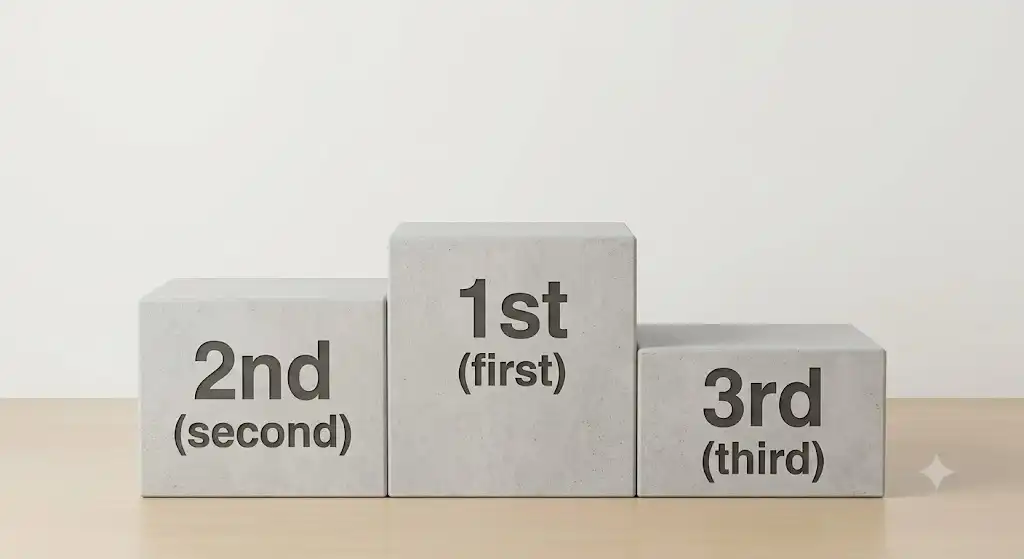
Now, let’s move on to ordinal numbers. Ordinal numbers are numbers in an order, in other words 1st (first), 2nd (second), 3rd (third) and so on. The word ‘ordinal’ is in the same family as the word ‘order’ and ordinal numbers communicate the sequence in a list of numbers. Listen to the numbers 1 to 10 as cardinal and ordinal numbers.
Number 1 (one) is the 1st (first) number.
Number 2 (two) is the 2nd (second) number.
Number 3 (three) is the 3rd (third) number.
Number 4 (four) is the 4th (fourth) number.
Number 5 (five) is the 5th (fifth) number.
Number 6 (six) is the 6th (sixth) number.
Number 7 (seven) is the 7th (seventh) number.
Number 8 (eight) is the 8th (eighth) number.
Number 9 (nine) is the 9th (ninth) number.
Number 10 (ten) is the 10th (tenth) number.
Now, after 10th (tenth) we have 11th (eleventh), followed by one more irregular ordinal number, 12th (twelfth). Then, the next group of numbers from 13th (thirteenth) to 19th (nineteenth) follow a pattern, which is quite easy to remember. All you need to do is add ‘-nth’ (N-T-H) as a suffix to the end of the cardinal number in order to create the ordinal number:
13 (thirteen) becomes 13th (thirteenth), 14 (fourteen) becomes 14th (fourteenth), 15 (fifteen) becomes 15th (fifteenth), 16 (sixteen) becomes 16th (sixteenth), 17 (seventeen) becomes 17th (seventeenth), 18 (eighteen) becomes 18th (eighteenth) and 19 (nineteen) becomes 19th (nineteenth).
From 20th (twentieth) to 90th (ninetieth) there is a very simple pattern for forming all other ordinal numbers. In fact, the only ordinals you need to learn are:
20th (twentieth), 30th (thirtieth), 40th (fortieth), 50th (fiftieth), 60th (sixtieth), 70th (seventieth), 80th (eightieth), 90th (ninetieth), 100th (hundredth), 1,000th (thousandth), 1,000,000th (millionth), 1,000,000,000th (billionth) and 1,000,000,000,000th (trillionth).
The reason that you only need to learn those ordinal numbers is because as soon as you start adding single-digit numbers to them, only the last element of a number is expressed as an ordinal number. All of the rest of the number looks and sounds like a cardinal number. Listen to these examples:
32nd (thirty-second), 132nd (one hundred and thirty-second), 1,232nd (one thousand, two hundred and thirty-second). 14,232nd (fourteen thousand, two hundred and thirty-second).
If you are reading the transcript while listening, you will notice that there is a hyphen (-) between the tens and the single digits, just as in the cardinal numbers.
Interestingly, there is one more ordinal number that is often used to describe a large and indefinite number. This ordinal number is ‘nth’. It is spelt N-T-H, but is pronounced ‘enth’. It comes from the mathematical concept ‘n’, which is an indefinite variable or the last number in a sequence. We use the word ‘nth’ as an adjective to describe the most recent time that something has been repeated in a very long, tiring sequence where the same thing happens again and again. It is most often used in the set phrases ‘for the nth time’ and ‘to the nth degree’. Listen to these examples:
He told us for the nth time that he was a doctor. He had been telling us again and again that he was a doctor. It was tiring and frustrating. Then he told us yet another time that he was a doctor. How annoying!
***
I revised to the nth degree for the exam. I prepared and prepared for the exam. Even when most people would say that enough revision had been done, I did some more preparation work. Perhaps I went too far. Perhaps it was too much and unnecessary, but I did it anyway.
***
I would like to look, very briefly, at ordinal numbers in calendar dates from January 1st (January the first) or 1st January (the first of January) to December 31st (December the thirty-first) or 31st December (the thirty-first of December). I have noticed that grammar reference books sometimes do not provide the information I am about to explain, although it is really important for saying dates. So, in English when you see a written date such as June 20th (June the twentieth) or 20th June (the twentieth of June), you must use the word ‘the’ between the month and the ordinal number if you say the month first, and you must use ‘the’ before the ordinal number and ‘of’ before the month, if you begin the written date with the ordinal number first. Here are some examples:
February 14th (February the fourteenth) is Valentine’s Day.
14th February (the fourteenth of February) is Valentine’s Day.
My birthday is on August 27th (August the twenty-seventh).
My birthday is on 27th August (My birthday is on the twenty-seventh of August).
***
Now, you may think that ordinal numbers after 31st (thirty-first) are quite rare, given that 31 (thirty-one) is the last possible day in a month. Although it is true that English people do not often use ordinal numbers after 31st (thirty-first), the ordinal numbers are still used in some set contexts. Listen to these examples:
***
It is my mum’s 50th (fiftieth) birthday on Monday 13th November (Monday, the thirteenth of November) and it is my dad’s 51st (fifty-first) birthday on Wednesday 7th March (Wednesday, the seventh of March).
In this phrase you can hear that English people say birthdays with the ordinal number. For example, ‘an 18th (eighteenth) birthday’, ‘a 21st (twenty-first) birthday’, ‘a 30th (thirtieth) birthday’, ‘a 40th (fortieth) birthday’, ‘a 50th (fiftieth) birthday’, ‘a 60th (sixtieth) birthday’, ‘a 70th (seventieth) birthday’, ‘an 80th (eightieth) birthday’, ‘a 90th (ninetieth) birthday’ and ‘a 100th (hundredth) birthday’.
***
In New York, the famous shop Macy’s is located on 34th (thirty-fourth) street.
In this phrase, you can hear that people say the names of streets in the cities of the United States of America with the ordinal number. People say, ‘42nd (forty-second) street’, not ‘the 42nd (forty-second street).
***
‘In 2012, Usain Bolt came 1st (first) in the 100 (hundred) metres at the London Olympics. I don’t run the 100 metres, but I run a marathon sometimes. In my last marathon, I came in 72nd (seventy-second) place. My sister also ran in the same marathon but she came 219th (two hundred and nineteenth).
In this phrase, you can hear that we use ordinal numbers for the positions in a race. The most important positions are 1st (first), 2nd (second) and 3rd (third) because those are the positions that win the gold, silver and bronze medals. When you describe a much lower place in a much longer race, such as a marathon, then you can say ‘I came 34th (thirty-fourth)’, ‘I was 34th’ or ‘I came in 34th place’. If your finishing position was after 100th (one hundredth) you can also use ‘place’, for example ‘I came in 146th (one hundred and forty-sixth) place.
***
The final thing to say about ordinal numbers relates to their use as adverbials. An adverbial is a word that usually ends in -ly (L-Y) at the beginning of a phrase. I remember that, when I was training to be a conference interpreter, my university lecturers told me that it was sometimes good to use the ordinal numbers ‘first’, ‘second’, ‘third’, ‘fourth’ and so on in place of adverbs. Their reason for suggesting this was because they believed that if you use ‘firstly’, ‘secondly’ and ‘thirdly’ you can only list a maximum of three items because words such as ‘fourthly’, ‘fifthly’ and ‘sixthly’ sound very strange indeed, even though they theoretically exist. So, if you are intending to make a list of more than three items, you can simply use the ordinal numbers instead of the adverbials. Here are two examples to illustrate this:
Firstly, I washed the outside of the car. Secondly, I vacuumed the inside of the car. Thirdly, I polished the car.
Here, there are only three items in the list, so it is perfectly acceptable to use the adverbials.
***
First, I washed the outside of the car. Second, I vacuumed the inside of the car. Third, I polished the car. Fourth, I washed the mats.
Here there are four items in the list, so I have used the ordinal numbers to avoid saying ‘fourthly’.
Obviously, there are many other ways to avoid saying ‘fourthly’, such as using ‘additionally’, ‘then’ or ‘finally’. However, if you really want to communicate the idea of numbered items in a list, then it is good to use the ordinal numbers in place of the adverbs ‘firstly’, ‘secondly’ and ‘thirdly’ if you intend to include more than three items.
***
In this second part of this Deep Dive I would like to look at numbers as adjectives. First let’s recall how the suffix -ish (I-S-H) is added to the end of cardinal numbers to create an estimate, close to the number, rather than the number itself. Thankfully, the rules for using ‘ish’ are not complex; you can simply add the suffix ‘-ish’ directly onto the end of the written number. If you use the numeral digits, then you should separate the numeral with a hyphen:
There were sixtyish (60-ish) people in the pub when I arrived.
I can’t get to your house at ten o’clock. I’ll come at twelveish (12-ish) after I finish work.
So, the suffix ‘ish’ is especially used to estimate the number of people at an event or to estimate a clock time.
You may remember, from the free episode, that the suffix ‘ish’ can be added to adjectives to say, ‘quite’, ‘to some degree’ or ‘somewhat’. Here are the most commonly-used adjectives with the suffix ‘ish’:
Youngish, oldish, tallish, smallish, longish, shortish, coldish and hottish.
Colours can also have the suffix ‘ish’ to communicate ‘quite that colour’ or ‘somewhat that colour’. So it’s possible to say reddish, bluish, greenish, greyish, whitish, blackish, and so on.
It’s not a good idea to invent new words with the suffix ‘ish’ because there are some adjectives that do not always work with ‘ish’. These include absolute adjectives, such as ‘dead’ or ‘married’. Either a person is dead or alive, so it does not make sense to describe a person as ‘deadish’. Likewise, a person is either married or not, so it does not make sense to describe a person as ‘marriedish’.
Furthermore, extreme adjectives do not sound correct with ‘ish’. Examples of this include ‘freezing’ and ‘unbearable’. You cannot say ‘freezingish’ or ‘unbearableish’ – it just sounds strange.
Finally, there are some adjectives that finish with the letters ‘ish’, and have become set words in their own right. Far and away the most common of these are ‘selfish’, ‘childish’, ‘foolish’ and ‘stylish’. If you want to qualify these you would need to use an adverb, for example ‘somewhat stylish’ or ‘relatively childish’, because you can’t say ‘childishish’.
***
To finish this Deep Dive, I would like to look briefly at using numbers as adjectives. Before we study individual examples, it is important to know the collocation ‘compound adjective’. A ‘compound adjective’ is an adjective that contains two (or more) words, but both words describe the same noun. In most cases, compound adjectives have a written hyphen (-) between the different elements (i.e. the words) of the compound adjective. The hyphen is needed to show that the words that make up the compound adjective are all part of the same adjective. You can’t ‘hear’ a hyphen; it’s only visible when you read written text. Here are two examples, using the highest-frequency compound adjectives:
Brad Pitt is a really well-known actor.
Here you can see that the adverb ‘really’ defines the compound adjective so it is not part of the adjective ‘well-known’. ‘Well-known’ is a compound adjective because it contains a hyphen between ‘well’ and ‘known’.
***
Until recently I had a part-time job working in a supermarket.
Here, ‘part-time’ is a compound adjective. Another similar compound adjective is ‘full-time’.
***
My brother’s short-term goals include getting fit and eating more healthily.
Here, ‘short-term’ is a compound adjective. The other highest-frequency compound adjectives in this family are ‘medium-term’ and ‘long-term’.
It’s important to have a basic understanding of compound adjectives when thinking about numbers used as adjectives because numbers are very frequently used in compound adjectives. Listen to these examples:
I went on a two-week holiday to France with my family and we stayed in a five-star hotel. We hired a four-door car, which was perfect for our needs. At the end of the holiday we decided to go camping and we used a six-man tent, which was really spacious!
Here, ‘two-week’, ‘five-star’, ‘four-door’ and ‘six-man’ are all compound adjectives. You will notice that when a number is part of a compound adjective, the noun after the number is always singular.
When talking about weights and quantities, numbers are often used in compound nouns. Here are two examples:
We bought a ten-kilo bag of rice and it lasted for a whole year!
They did a twenty-kilometre walk through the countryside.
***
Without a doubt, the most common use case for numbers in compound adjectives is to describe age. Listen to these examples:
I have a twenty-five-year-old daughter and a twenty-year-old son. That is to say that my daughter is twenty-five years old and my son is twenty years old.
Can you see in this example that the compound adjectives contain several words? It is absolutely correct to say ‘a twenty-five-year-old daughter’ even though the compound adjective contains four words and three hyphens! All of the words in the compound adjective are connected by hyphens to show that they all describe the same noun.
***
There is one case when numbers are pluralised, and this is when they are used to refer to the approximate age of a person. In this case, the numbers are used as nouns in a set phrase, not as part of a compound adjective. Listen to these examples:
My wife and I are both in our 50s (fifties) and our children are in their 20s (twenties).
The set phrase is ‘to be in your twenties, thirties, forties, fifties, sixties, seventies, eighties or nineties. It’s particularly useful when you are guessing someone’s age within ten years. For example, ‘I think my uncle’s in his 80s (eighties), but I can’t be sure’. We use the word ‘teenager’ for anyone whose age corresponds to the -teen numbers (thirteen to nineteen).
***
Well, we have reached the end of this Deep Dive on using numbers. I hope very much that it has been useful for you and has helped you with areas that were difficult for you or enabled you to learn something new. As always, thank you so much for your support and I look forward to seeing you next time.
Join the Linguacade Patreon community to unlock full transcripts and audio for all levels (£4/month for total access)
Leave a Reply