Author: Jason

  • 1 Greetings in English (A1)

    1 Greetings in English (A1)

    Hello, I am Jason. It is nice to meet you! This is the long form.

    Hello, I’m Jason. It’s nice to meet you! This is the short form.

    Hi, I’m Jason. Nice to meet you! This is the very short form.

    What is your name? This is the long form.

    What’s your name? This is the short form.

    I am an English teacher. You are a student of English. This is the long form.

    I’m an English teacher. You’re an English student. This is the short form.

    Listen to these phrases and say them after me:

    Hello, I am…

    Hello, I’m…

    What is your name?

    What’s your name?

    I am a student of English

    I’m an English student

    I am from England. This is the long form.

    I’m from England. This is the short form.

    And you? Where are you from?

    I live in Torquay. Where do you live?

    Listen to these phrases and say them after me:

    I live in…

    Where do you live?

    How are you?

    I am fine, thank you. This is the long form.

    I’m fine, thanks. This is the short form.

    Here are some more positive phrases:

    How are you?

    I’m great. (This is very positive)

    I’m fine. (This is positive)

    I’m good. (This is positive)

    I’m okay. (This is quite positive)

    I’m not bad. (This is neutral)

    I’m not great. (This is negative)

    Now listen to these conversations:

    Hello, I’m Jason. I’m a teacher and I live in Torquay. I’m great. How are you?

    Hi! How are you? My name’s Steve and I’m from England, but I live in Dubai. I’m fine.

    It’s nice to meet you! I’m Joe and I’m from Bristol. What’s your name? How are you?

    Now listen to these numbers:

    + = plus

    0 = zero (or ‘oh’)

    1 = one

    2 = two

    3 = three

    4 = four

    5 = five

    6 = six

    7 = seven

    8 = eight

    9 = nine

    10 = ten

    Hi! What’s your phone number? Mine is +44 2875 669 318 (plus four four; two eight seven five, six six nine, three one eight).

    Hello, I’m Paul and my mobile number is +53 1095 2489 217 (plus five three; one zero nine five; two four eight nine; two one seven).

    Remember that ‘telephone’ is the long form, ‘phone’ is the short form and ‘mobile’ is only for your personal, mobile phone.

    Now listen to these words:

    Goodbye!

    Cheers, bye!

    See you soon!

    See you later!

    See you this afternoon!

    See you this evening!

    See you tomorrow!

    Finally, listen to these phrases:

    Hello, I’m Andy and I’m from Bristol but I live in London. How are you? I’m fine. My mobile number is +44 08862 475 329. What’s your telephone number? Cheers, bye!

    Hi, I’m Abdul and I’m an English student. I’m from Paris but I live in London. My phone number is +33 2181 0965 0348. See you this evening. Goodbye!

    Thanks for listening. Please go to linguacade.com to get the free transcripts for all my lessons.

    If you enjoy my content and want to improve your English even faster, please subscribe to the Linguacade Deep Dive on Patreon. Every Deep Dive episode explains the special words and phrases highlighted in bold in your free transcripts and subscribers get access to all Deep Dive episodes and transcripts for all levels. I’ll see you there.

    Unlock the Deep Dive: If you enjoyed this lesson, join the Linguacade Patreon for just £4/month. Get instant access to exclusive masterclasses covering every highlighted word and phrase in the Beginner, Intermediate, and Advanced episodes.

  • BDD 1 Be, live, say and listen (A1)

    BDD 1 Be, live, say and listen (A1)

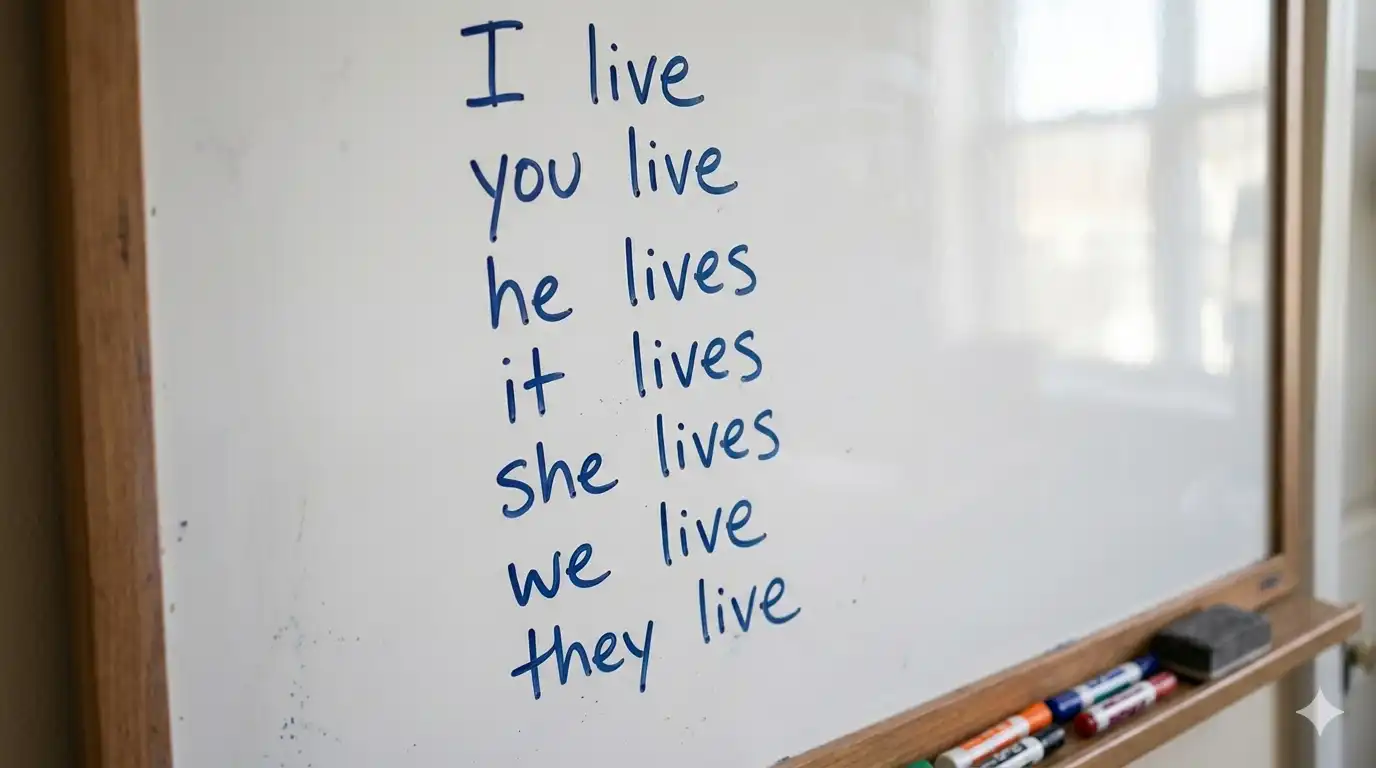
    Welcome to the first Beginner Deep Dive from Linguacade. This Deep Dive will help you to practise phrases from the Beginner podcast episode 1 and it will also help you to learn four important verbs in English: ‘to be’, ‘to live’, ‘to say’ and ‘to listen’.

    Join the Linguacade Patreon community to unlock full transcripts and audio for all levels (£4/month for total access)

  • 1 Meet your teacher (B2)

    1 Meet your teacher (B2)

    In 1992 I was 18 years old and I was just finishing secondary school in Torquay, a seaside town in South West England. My mother worked as a teacher of English as a Second Language (ESL) in a local language school. There was a shortage of part-time teachers that summer and the school badly needed to find qualified people who could take on some of the extra work.

    My mother casually mentioned to her boss, the language school principal, that I was looking for a part-time job. She explained that, although I didn’t have the correct qualification to be an English teacher, I had completed my final school exams. One of these exams was an A-level (Advanced level) in English Literature. At that time, in the summer of 1992, I hadn’t yet received the results of the exams, so I didn’t even know whether or not I had passed the English Literature exam.

    The principal must have been pretty desperate because she chose to employ me as a part-time teacher of English anyway. Previously, I had worked as a cashier in a local shop and as a barman in a pub, so the opportunity to earn more money and do a more interesting job was quite a step up for me.

    When I first went into a classroom at that language school, I was very nervous. The adult students looked at me suspiciously and curiously. I knew what they were thinking: ‘How old is this teacher? Is he qualified? He looks like a teenager.’ Thankfully, my mum was able to help me prepare lessons and I believe I did an acceptable job.

    Over the next five years, I worked at that local language school during the summer holidays. I was very grateful for the experience that I got there because it helped me to understand the problems and the challenges that people have when they study another language.

    In 1993, after completing a sabbatical year, during which I worked as a volunteer missionary in France and Africa, I went to Cardiff University in Wales to study French and Spanish. Before starting university, I had not studied Spanish, so it was both stimulating and difficult. The university had two first-year Spanish groups. The advanced group was made up of students who had studied Spanish at school and the beginner group was made up of students who had never studied Spanish before. My Spanish teachers told me and the other beginner students that the beginner and advanced group would be merged after the first year and would then study together for the rest of the course, which was 3 more years. This was a little scary for me. I wondered how it might be possible to improve enough in Spanish to be able to study with the advanced students because they had already had seven years of Spanish experience from their school career before starting university.

    It was indeed a challenge, but I finished my undergraduate degree in the summer of 1997, qualifying with first-class honours in French and Spanish. After finishing at Cardiff University, I married my childhood sweetheart Sue and we moved together to the city of Bath in the south of England, so that I could complete a postgraduate diploma in interpreting and translating. Sue was from Helsinki, Finland (which is a country in the north of Europe). She had an English mother and a Finnish father, so she was bilingual in both English and Finnish.

    While studying for my postgraduate diploma I started learning Finnish and it was a big shock. Whereas French and Spanish had been relatively easy to learn, Finnish seemed impossible to me. I tried very hard but I didn’t feel as though I was making any progress because the structure of the language was so different from English. This frustration I had with Finnish made me think a lot more about some of my students at the language school. I realised that students whose first language is very different from English would find English very difficult to learn and I developed a new, deeper respect for their struggle and their commitment.

    As part of my training to be a translator and interpreter, I completed a short placement at the World Trade Organisation in Geneva, Switzerland, in spring 1998. I had the opportunity to go into the interpreting booths and listen to the professional interpreters interpreting between French, Spanish and English. I was also given the opportunity to take a short test in which I practised interpreting with a microphone that was switched off while the head interpreter listened to me and evaluated my performance. After my test, the head interpreter said that I had done well. She told me that if I came back to Geneva after finishing my diploma, she would give me some freelance work as a conference interpreter.

    This was an incredible opportunity and the chance of a lifetime. In those days, in the late 90s, it was hard for young and inexperienced interpreters to find work so the offer of some part-time work as a freelancer was something very important to me. However, when I went back to Bath to talk to my wife Sue about moving to Geneva after the course, she received an exciting opportunity. Sue’s cousin, who worked for the company Nokia Networks in Finland, offered Sue a job at Nokia in Helsinki, Finland.

    Now, we were in a difficult situation. There were two completely different career opportunities ahead. Either I could go with Sue to Finland and sacrifice the offer of work as an interpreter in Geneva or Sue could come with me to Geneva and sacrifice the job offer that she had received from Nokia Networks. The choice was a real quandary because there were no obvious opportunities for me in Finland and Sue did not speak French, which is the language spoken in Geneva. What’s more, Sue had already sacrificed a year to be with me in Bath. She was a qualified electrical engineer and she wanted to get experience in engineering, which was difficult in Bath because there were few job opportunities for her.

    We talked about the situation and asked for advice from our friends and family. They were helpful but did not want to interfere too much. They believed that it was our decision to make as a couple. Eventually, I decided to speak to my course director at Bath University. I explained the situation carefully and asked him what he would do if he were in my position. To my surprise, he answered without any hesitation and said, ‘You should definitely go to Finland’. This was not what I had expected. He explained to me that because Finland had recently joined the European Union (EU) in 1995, there were still very few people who could translate and interpret between Finnish and English. He suggested that I go to Finland with my wife Sue and that I work hard on my Finnish so that I could use the skills I had learned on my postgraduate diploma course to translate and interpret from Finnish to English.

    I’m very pleased to say that I took his advice. Sue and I moved to Vantaa, Finland in July 1998. She started a career as an engineer at Nokia Networks and I worked hard to improve my Finnish. In early 1999, I had my first opportunity to interpret from French to English at an international conference. It was terrifying because the first person to listen to me interpreting was the then Finnish Prime Minister, Paavo Lipponen. All in all, Sue and I spent 5 very happy years in Finland. I love the country and the people so much that it is difficult for me to express my feelings in words. I learned Finnish well enough to use it professionally and I got a lot of experience as a translator and interpreter.

    In summer 2003, Sue and I moved back to Torquay, South West England. There were many reasons for this decision, but it was not easy for me to leave Finland. For approximately two years, I continued to work as a freelance translator and proofreader. Sometimes I went back to Finland to interpret in conferences. Ultimately, however, I realised that it was very important for me to recalibrate my life and focus on England. Whenever I went back to Finland to work and I walked around the streets of Helsinki, I felt sad and I missed the city. After each trip, I returned to England and I spent a lot of time thinking about our former life in Finland.

    This was not helpful or useful for me or for my family. Then, one afternoon in spring 2005, I was shopping in a local supermarket when I bumped into my old French teacher from school. We chatted for a few minutes. He told me a little bit about his life and he asked me what I was doing now. I explained what was happening with my trips to Finland and told him that I was currently rethinking my career. Just as my course director at Bath University had done in 1998, my old French teacher made a suggestion. He said, ‘Why don’t you become a secondary school teacher?’

    He explained that there was a real shortage of language teachers in the UK and that Spanish was becoming more and more popular as a second language. However, there were few qualified Spanish teachers working in secondary schools.

    I returned home and thought about his suggestion. I realised that, if I retrained as a language teacher, I would be able to refocus my attention on the local community. This would help me to stop thinking about Finland and find a new career focus that would give me new skills to use with my languages. I consulted Sue and my family, who all agreed that it would be a very good idea.

    So, in September 2005, I started training to be a Modern Foreign Languages (MFL) teacher, initially with French and Spanish. As a part of my training, I completed two placements in different schools. Then I got a job as a teacher of French and Spanish at a local secondary school, Churston Ferrers Grammar School, and I began working there in September 2006. That year, the school introduced Spanish, as a second language option for pupils, alongside French and German, so I had the privilege of co-teaching the first group of beginner Spanish students. After my first year, I became head of the Spanish department.

    All in all, I worked 16 years at Churston. During that time, I taught myself Italian sufficiently well to teach it to some students who needed qualifications in Italian so that they could access university courses. In 2018, I went on an incredible adventure with my family to South Island, New Zealand, for a year-long sabbatical where I was head of the languages department at a school in Christchurch, covering for a teacher and friend who was on maternity leave.

    In spring 2019, I returned to my old position in the school in England. During the Covid-19 pandemic, I worked from home and taught pupils online. With the extra time I had from the lockdowns in England, I started teaching myself Swedish using podcasts rather than traditional methods of studying. This helped me to reflect deeply on the power and value of podcasting as a medium. I started dreaming of one day creating my own podcast.

    In September 2022, I made the decision to quit secondary teaching. I wanted very badly to do something different and a part of me longed to be my own boss again. Before leaving my secondary teaching job in July 2023, I had been reflecting on the start of my career and thinking about how wonderful it had been to have my own small company in Finland. I remembered the feelings I had when I was working as a translator from home in our flat in Vantaa and I wondered whether it might be possible to have autonomy over my own work life once again.

    It was a complete leap of faith to leave my job because I did not have another job to go to. Instead, I decided to do something that I had been intending to do for 30 years, which was, finally, to get a qualification as a teacher of English as a Second Language (ESL). It was poignant and perhaps a little ironic that the best course provider was the school where I had accidentally started my teaching career in 1992, more than 30 years previously. I completed the CELTA course (Certificate in Teaching English to Speakers of Other Languages) and was very grateful to get work almost immediately in another international language school very close to where I lived.

    For the next 2 years, from January 2024 to January 2026, I had many incredible times. It felt absolutely right and fitting to be back where I had started, but this time with the experience of two very different careers in languages. I felt strongly that I was in the right place at the right time. Having studied or taught French, Spanish, Finnish, Italian and Swedish I was finally able to teach English, but this time with more confidence and authority. I asked my boss for as many different teaching opportunities as possible, so that I could get experience with every level and every possible dynamic. I had large groups of teenagers, one-on-one lessons with professionals, intensive groups studying for the IELTS exam, absolute beginners who were unable to speak English at all when they arrived at the school, and even students who were themselves teachers and experts in English.

    I had a strong sense of empathy for my students, who came from every continent, and spoke many different languages. More than anything, I wanted to know about their experiences learning English and understand how best I could help them. I began thinking seriously about how, when I was studying other languages, I had benefitted from the kindness of other teachers who had created free podcasts and given away free resources. An idea began to take shape in my mind; perhaps it would be possible for me to start a small podcasting business which I could use to give resources to people who wanted to learn English.

    In January 2026, I finally started building the ecosystem for my website and, in mid-March, I recorded this, the first episode of the Intermediate podcast.

    Thank you for listening. If you’d like to follow along with the text, head over to linguacade.com to find the free transcripts for all my episodes.

    If you’re ready to take your English to the next level, I’d love for you to join the Linguacade Deep Dive on Patreon. In every Deep Dive, I break down the sophisticated vocabulary and phrases highlighted in bold in your free transcripts. Plus, as a subscriber, you’ll have full access to the entire archive of Deep Dive masterclasses across all levels. I’ll see you there.

    Unlock the Deep Dive: If you enjoyed this lesson, join the Linguacade Patreon for just £4/month. Get instant access to exclusive masterclasses covering every highlighted word and phrase in the Beginner, Intermediate, and Advanced episodes.

  • 1 The dead internet theory and generative AI (C2)

    1 The dead internet theory and generative AI (C2)

    When I was teaching English in a local language school I used to ask my students the question, ‘Let’s imagine you’re using a learning platform, a website or a resource to study English, how do you feel if you suddenly discover that the content you’re consuming has been created entirely by generative AI?’ It’s a question that has become increasingly salient in recent months, not least because the quality of AI-generated content has improved so dramatically that it is now virtually indistinguishable from content generated by humans.

    Interestingly, all my students gave more or less the same answer. It was something along these lines: ‘The moment I find out that what I’ve been reading, watching, or listening to was generated by AI, I immediately stop.’ Students described feeling angry, frustrated, cheated, disappointed and disgusted. The list of negative adjectives goes on.

    When I decided that I was going to start a podcasting business and shared my vision with other people, it raised a few eyebrows. I knew what people were thinking and – to some extent – I thought it myself. What earthly point is there investing thousands of hours writing my own content when I can ask an AI to populate a complete branded network on my behalf, replete with technically perfect lessons, all read by a digitised voice clone that can perfectly replicate my voice with every flaw and quirk.

    Almost on a daily basis, I read some scaremongering article about how we’re sleepwalking into complete catastrophe; how the vast majority of jobs currently done by people will soon be fully automated and that, therefore, most white-collar workers will become redundant and lose their jobs. It’s ironic, of course, that the writers of these articles (or warnings) are often software engineers who have been partly responsible for programming the very AIs that will take their jobs.

    But I digress.

    Let’s return, for a moment, to the reactions of my students. Their negativity about being duped was so strong it felt almost militant, but it gave me a little hope for my own business. You see, I was polling my students because I had a hypothesis about how parts of this situation might play out in the long run. Perhaps it wouldn’t be the total doomsday scenario that these software engineers were envisaging.

    Not too long ago, I felt I needed to brush up on my Finnish, which had become rather rusty from lack of speaking and listening. I stumbled on a podcast that looked perfect for my needs and I subscribed. At first it seemed fine: an inoffensive and informative podcast at native-speed Finnish. But as I marched through the episodes a seed of doubt began to grow within me. Something was not quite right. The voice narrating the episodes had all the usual human flaws, but there was something too perfect – almost robotic – about those flaws. Then, there was the diction. Sometimes the voice rushed through sentences and phrases, when pauses would have been appropriate. Furthermore, at the end of each episode there was a ‘language focus’ that looked at the ‘key’ words from the episode, but there was something quite strange – baffling even – about the words that were chosen for the focus. They seemed to have been picked entirely at random, and certainly did not represent sensible or rational choices based on the content of the podcast. Most of them were either elementary, or very low-frequency, words. I started to have a sneaking suspicion that the entire podcast (content and voice) was AI generated. Then, when I was in the middle of a particular episode, the female voice narrating the content suddenly degenerated into gibberish and started reeling off a series of random numbers and code that made absolutely no sense. Not only had the podcast been generated by AI, but whoever had devised the prompts hadn’t even bothered to check the integrity of the content by listening back to it before publishing. I was really furious.

    It took me a while to get a handle on my feelings. It’s not often that I get disproportionately angry about something as innocuous as a podcast, but I’ve learned the lesson that when I feel enraged about anything, it’s definitely worth digging into why. That’s a basic application of metacognition. So, I took a step back and analysed the situation rationally and dispassionately. Why did I feel the way I did? Sure, there was the usual feeling of having been cheated by some hidden human grifter looking to capitalise on my gullibility. I think everyone would feel that; I certainly see a lot of anger and frustration in the comments sections beneath sensationalist AI-slop photos of car accidents or natural disasters. What intrigued me was a deeper intangible and elusive feeling behind the anger. I can only describe this feeling as a combination of longing for real human connection and a vague sense of panic that the internet – previously a space inhabited by genuine human voices – was fast becoming a digital wasteland; a place where exponential volumes of content were being pumped out by generative AI and then commented on by AI bots, creating an endless feedback loop of ever-diminishing quality; huge echo chambers inhabited by millions upon millions of bots discussing real-life situations that they had never experienced.

    And that was it – I had successfully identified that elusive feeling. It was a fear of losing the opportunity to share the experience of being human with another person. Now I understood why my students were enraged. At the core of our soul we long for connection with other people because, of course, other people have experienced real life. Until now, no other generation in human history has had the privilege of being able fully to understand this because no other generation has been faced with a massive proliferation of content that purports to have experienced life but, in reality, has no understanding of what life really is. It’s both sobering and terrifying when you think about it. Whether we are capable of articulating it or not, we are angry when people foist AI-generated content on us because it is fraudulent. It is fraudulent because it claims human experience when it has no human experience. It’s a deliberate, scurrilous deception.

    It’s wrong for us to be angry with AI per se. In my daily scrolling I see a lot of vague anger channelled towards AI and I think it’s misdirected. As yet – to my knowledge – AI has not become fully sentient, nor has it launched some Terminator-like offensive against humanity. As far as I know, AI does not currently have a vendetta against the human race.

    I do, however, believe there is a fairly clear dichotomy between, on the one hand, AI that people use in order to assist them in doing things that will generally build the user’s skillset and, on the other, AI that bad actors exploit to generate content that they pass off as having been created by people when it was not. The problem here is the people who harness AI to deceive others. That’s not the fault of the AI, it’s the fault of the people who prompt it. Taking this further, even AI bots that act autonomously, flooding comment sections with fake, agenda-driven or deliberately misleading comments, are only there, and only exist at all, because they have been programmed and initiated by people with bad intentions. We have every right to be furious with the fraudulent bad actors who attempt to trick us into believing that the AI content we’re seeing, hearing and reading is founded on human experience. An extreme example of this is a female writer with the pseudonym ‘Coral Hart’ (anonymous, of course), who boasted that she was making a six-figure salary annually by getting AI to write novels in as little as 45 minutes, which she then published, passing them off as written by humans.

    On the other side of the dichotomy is what I would call ‘good’ or ‘beneficial’ uses of AI. I wouldn’t describe myself as a particularly technical person and, when I was a child, I used to dream of a time when it might be possible simply to use plain English to ask a computer to help me solve problems and learn new things. That time has now come. Well, almost. When I bought the domain name linguacade.com I decided to host it with a company that offered to create a free website in minutes using its own proprietary AI. It failed spectacularly. I realised that, in order to create a learning platform with its own functioning ecosystem, I would have to roll up my sleeves and start learning some technical things. So, I set about building the site myself, this time with AI as a guide. I asked it dumb question after dumb question about the most basic elements of the WordPress block editor. I imagined it rolling its eyes at the stupidity and repetitiveness of my questions, which it certainly would have done if it was sentient. But – and here’s the thing – at the end of the process, I had actually learned how to build a basic website and would arguably be able to do it again more quickly and without so much hand-holding from AI.

    I went through almost exactly the same process in creating a font for the Linguacade brand. Initially, I was wooed by the clickbait ads offering an AI solution to create a font on my behalf in a matter of minutes. Then, when I realised that I would never really own or control the AI-generated font, I set about designing it myself but this time using AI as a guide. FontForge, the open source software I used to create my font is not for the faint of heart and it’s certainly not designed for people without technical expertise. But, by the end of the process and with the endless patience of my AI assistant, I had managed to create and publish a font of my own, which now appears in the podcast cover art and on my site. If I were asked to design another font in the future, I would probably be able to do it with significantly less help from AI.

    That’s when I finally understood the fundamental dichotomy in AI use. It is the difference between AI used to develop a prompter’s skillset and AI used by a prompter to deceive for personal gain. In the first case, a user leverages AI for personal betterment. They want to assimilate the knowledge provided by AI so that they improve as a person and do it themselves next time. In the second case, a user exploits AI to deceive others in order to gain some kind of advantage, which is usually financial. In this case there is no learning, no self-improvement, and no added value for anyone in the process.

    Getting AI to do something for me when I could, with some guidance, learn how to do it myself is a bit like deciding to go on a hike with a guide only to change your mind at the last minute when you see the challenging terrain ahead and tell the guide, ‘Listen, why don’t you do this on your own? I’ll wait here and have a coffee and a doughnut while you climb those steep hills. Take some photos and when you come back we can just pretend that it was I who did the hike. We’ll photoshop me into a few of the images, make them look like selfies and I can post online about how great the hike was.’ What’s the point of doing that? It completely defeats the object, as anyone who has handed in an AI-generated essay with their name on it, will know. But if I decide to do the hike anyway, acknowledging that (a) I’m doing it with a guide and (b) my guide will always be there to help and support me when it gets hilly, then I return from the experience stronger and probably more willing to repeat the experience in the future.

    I know that, for many people, AI is the guide they always wished they’d had, and that their experience with it has genuinely helped them learn new skills that they can use in the future. But, unfortunately, it doesn’t seem like that’s the general trend for AI use. Time and again, our online experience shows us that many people have abdicated and handed over all creative control to AI. In other words, a lot of people are choosing to send the guide on the hike, pretend that they did it themselves and go out of their way to lie about it on any platform that will publish the resulting slop.

    And the statistics seem to back this up.

    There’s a conspiracy theory that started to gain traction about ten years ago. It’s called the theory of the dead internet. It postulates that, whereas in the past, the vast majority of online content was generated by people and only a tiny proportion was created by bots, now, with the advent of hyperintelligent generative AI, exactly the reverse is true. But not only that; now the relative proportion of human content online is shrinking exponentially. It’s as though the current evolution of the internet reflects one of those videos that presents the sun in our solar system as something enormous and majestic and then zooms out until it becomes an almost-invisible dot alongside red hypergiant stars such as VY Canis Majoris or UY Scuti.

    We currently have no way of knowing for certain how much of the internet is a dead wasteland of artificially-generated content. According to some reports we have already reached a tipping point at which approximately 51% of total web traffic is generated by bots. Allegedly, this figure is predicted to rise to 99.9% of all internet traffic in the not-too-distant future. That is to say, it’s entirely possible that human online traffic may account for only 0.1% of all internet activity, and synthetic AI traffic may account for the other 99.9%. By the time our children have grown up, human-generated content may represent the equivalent volume of our sun next to artificial content of such unimaginable volume that it could be likened, in relative size, to the ultramassive black hole Ton 618.

    So, on the one hand, you have utter frustration from people who want genuine connection with content that tells a human story and is the fruit of personal sacrifice and, on the other, you have the likelihood that, within a few years, virtually all online content will have been generated by bad actors using AI to deceive directly or programming bots to do it autonomously. It’s crystal clear what this means: content created by people will become a very rare commodity. People want human content. Ipso facto, people will not become redundant in every area.

    When I say there is ‘hope’, I don’t mean that we will somehow avoid the doomsday scenario of AI taking the vast majority of clerical, administrative and data jobs. But I am saying that there is still a conversation to be had about how much people value something personal, even if it’s flawed and imperfect. Considering the fact that publicly-available AI models have only very recently been able to produce something sufficiently close to digitally-perfect representations of reality that we can barely tell the difference, it’s nevertheless surprising how quickly folk have grown tired of such representations – and how angry they are when they are duped by them. Again, I must stress that I am talking specifically about those uses of AI that falsely claim to be human experiences or to represent human creativity.

    We need to talk more about how we can leverage the motivation that is generated by this anger and frustration to find ways that flawed, meaningful content, made by real people who sacrificed their time to make it, can be encouraged and enshrined. Some of my friends tell me that attempting to distinguish fact from fiction has caused them to become so discombobulated with their social media feeds that they have switched off in disgust and now often think twice about accessing social media at all. Good! It’s ironic and somehow satisfying that all these deceptive attempts to monopolise our attention may actually backfire on those who devised them, to the point that swathes of people stop giving them any attention at all.

    It is a strange and disruptive time to be a digital creator but at least our remit is 100% clear. Even if the volume of our content turns out to be infinitesimally small in the grand scheme of things, and even if the hike to create it takes hours, we owe it to our fellow human beings to be genuine: to go the extra mile and do it ourselves.

    Thank you for listening. You can find the full transcripts for every episode at linguacade.com.

    If you want to completely transform your English language expression, join me on Patreon for the Linguacade Deep Dives. In these sessions, I break down the meanings, nuances, applications and etymology of the phrases highlighted in bold throughout the transcripts. Subscribers get full access to the complete masterclass archive across all levels. I look forward to seeing you there.

    Unlock the Deep Dive: If you enjoyed this lesson, join the Linguacade Patreon for just £4/month. Get instant access to exclusive masterclasses covering every highlighted word and phrase in the Beginner, Intermediate, and Advanced episodes.

  • ADD 1 How to spot a grifter (C2)

    ADD 1 How to spot a grifter (C2)

    When I reviewed the content and vocabulary from episode 1 ‘The dead internet theory and generative AI’ there was a common thread, namely that of people exploiting AI for personal gain. For this reason, I chose the following key words for part 1 of the Deep Dive: grifter, bad actor, to foist something on someone, to pass something off as, to be wooed by, to turn out to be.

    When I think of the word ‘grifter’, I have a very specific picture in my mind of the kind of person defined by the word. The picture I have has taken shape over the years, growing and changing as friends, colleagues and acquaintances have defined people I knew as ‘grifters’. So, if I hear the word it triggers a kind of generic profile in my mind; that of an utterly charming but very dangerous person. Grifters are extremely charismatic and attractive. They are engaging and entrancing to the point of having what one might describe as a magnetic personality. They have a way with words and are able to create the most convincing and winning arguments. The new people a grifter meets are immediately wooed by – or persuaded by – his energy, passion and conviction. At first, a grifter’s motivations and projects seem highly plausible and judicious, but then something strange happens. The veneer appears to fade as people who were initially so impressed by him begin to realise that he is playing them and exploiting their good faith for his own benefit. This is because, in essence, a grifter is a con man and a calculated exploiter of those around him. A grifter is a bad actor, which means a person who acts in bad faith in order to profit from others. When this becomes evident to the other people, they stop seeing the persuasive talk as convincing and start seeing it as glib; superficial and insincere. All the smooth talk ultimately turns out to be nothing more than hot air.

    Grifters are always looking to foist things on other people. When I say ‘foist’, I mean ‘push’, so ‘to foist things on someone’ means to try to get someone to accept something that they really don’t want. One kind of grifter may use smooth talk, flattery and persuasion to foist his responsibilities onto the shoulders of other people, so that they wind up doing his work for him. Another kind of grifter may try to foist physical products on other people. He may be a salesman offering something that seems too good to be true, and which turns out to be valueless.

    The noun ‘grift’ is the word used to describe the particular scam or fraud that the grifter operates. You can also say ‘to run a grift’, meaning ‘to operate a scam’. There are many, many types of online grift. There are, for example, those in which people claim to be content creators, but have actually done little or no work themselves, instead using AI to do it on their behalf.

    Another common grift is that of creating a meme-coin cryptocurrency, which appears to be an attractive investment opportunity, when the project turns out to have no practical use case. The grift involves generating interest in the cryptocurrency and wooing early investors to part with their money, usually with promises of fantastic returns on their investment. Those who run this kind of grift pass the meme-coin off as something of genuine value and something that solves a real world problem when, in fact, it is completely worthless. The money that hapless victims invest in the coin is called the ‘pump’, which raises the value of the coin, and this is followed by the ‘dump’ whereby the grifter who created the coin sells his or her entire portfolio of the meme-coin and pockets the proceeds. The value of the coin then plummets (i.e. falls sharply), making the portfolios of investors worthless. This ‘pump and dump’ scam is also called a ‘rug pull’ and comes from the phrase, ‘to pull the rug out from someone’s feet’. If you are standing on a rug and someone pulls it sharply, you will fall over. If you invest in a pump and dump scam, you will suffer.

    One more online grift worth mentioning is short-form video ads (or reels) on social media that sell online courses about how to sell an online course. Even saying it out loud sounds completely ridiculous, but there are people charging an absolute premium for their incredible online course that will teach you how to sell – wait for it – an online course. At no point in this grift is there any mention of any content that actually adds value, but there is plenty of talk about how selling such a course will provide fantastic revenues. Here’s how it works. Grifter A creates a course which promises to help victim A sell a course online. The course itself is nonexistent. It’s not as if the grifter is selling a course on how to get fit or learn Arabic; there is precisely zero added value. Victim A spends the money on the course and learns the grift, but has no course to sell on to other people, only the knowledge of how to create a course to sell a nonexistent course. Victim A then becomes grifter B and foists the course on victim C. And so on and so forth. It’s a thoroughly depressing circular logic that would be far less successful if the victims were not so desperate to find some alternative means of income. And here I hold my hands up and admit that, when I was looking for an alternative to secondary teaching, I was wooed by these bad actors and I even bookmarked a number of their videos. On second viewing, the videos seemed increasingly suspicious or just plain fishy. Many of them contained images of the fantastic wealth that the grifter had accumulated, presumably as some kind of social proof that the project had been a resounding success. I found myself wondering why a person would feel the need to flash the cash. Most wealthy people I know are very circumspect about their money and go out of their way not to draw attention to themselves. I learned subsequently that the cars and mansions in these videos are usually rented by the grifter who passes them off as his own.

    Grifting is nothing new. Years ago, my brother and I went to a funfair that was visiting our town for the summer. It was replete with all the usual rides, slides and stalls. One of the stalls was a game where you needed to throw wooden rings over bottles of soft drinks that were mounted on wooden plinths. Incidentally, a plinth is a square block used as a base or foundation. In any case, if your ring went over the bottle and the wooden plinth you won the bottle. My brother was interested but suspicious. He paid for a turn and was given five rings. Although he managed to throw a couple of them over the bottles, not one of the rings went down to the bottom of the plinth, which was a prerequisite for winning the bottle. He was annoyed and had a hunch that this might be some kind of scam, so he asked the stallholder to demonstrate that the rings actually fitted over the wooden plinths. At first, the stallholder refused but my brother kicked up such a fuss that he eventually gave in, picked up a ring and pushed it down one of the plinths. I say ‘pushed it down’ because the ring touched the edges of the plinth. That meant, of course, that the force of gravity would never be sufficient to enable a ring, thrown at an angle to fall down to the bottom of a plinth. The stallholder was therefore a grifter (in this case, a small-time scammer running a repetitive scam).

    To finish this first part of the episode, I’d like to look a little more closely at the phrase ‘to foist something on someone’. I mentioned previously that it means to try to get someone to accept something that they really don’t really want. If someone foists something on you, they are forcing you to accept something that you don’t want. A typical use of this term would be an employee who says, ‘My boss foisted this report write-up on me at four o’clock on Friday afternoon’. In this scenario the boss has a report to do. He’s too lazy to do it himself so he gives it to his subordinate. The subordinate can’t very well say, ‘no’ to this because he doesn’t feel comfortable refusing his boss. ‘Foisting’ can therefore refer to tasks, ideas or obligations just as much (as) to physical things, such as poor-quality products. If you say that someone foisted something on you, you are communicating that (a) you didn’t want it, (b) you don’t approve of the person who did it and (c) it was imposed on you against your will.

    In the second part of this episode, I’d like to look at some general words and phrases that appeared in episode 1 of the free podcast, but which aren’t related to each other in any particular way. In this part, I’ll read sentences that appeared in the transcript of ‘The dead internet theory and generative AI’ and examine key words and phrases that it contains.

    ***

    ‘When I decided that I was going to start a podcasting business and shared my vision with other people, it raised a few eyebrows.’ ‘To raise a few eyebrows’ has quite a nuanced and specific meaning. When people register surprise on their faces, they sometimes raise (lift) their eyebrows to indicate this surprise. However, even though they raise their eyebrows they may not actually say anything to indicate why they are surprised. So the phrase ‘it raised a few eyebrows’ indicates that people expressed surprise without necessarily saying anything, perhaps out of politeness or the desire to avoid conflict. The phrase is both an idiom and a set phrase, which means that it almost never changes in form. Here are some example phrases:

    ‘The actor’s critical acceptance speech raised a few eyebrows with its boldness.’

    ‘We certainly raised a few eyebrows with our risqué fancy-dress costumes.’

    As you may know, English people tend to imply meaning rather than expressly state it. The expression, ‘It raised a few eyebrows’ may appear to communicate that a few people were mildly surprised. In reality, it could communicate that the reaction was relatively strong even if people didn’t speak out negatively about my decision. When I told people that I intended to start a podcasting business quite a number of people expressed surprise, given the proliferation of AI-generated content, but were careful not to criticise openly. So, in this case, ‘it raised a few eyebrows’ in fact means, ‘quite a number of people were surprised but were careful not to criticise openly.’

    ***

    ‘…replete with technically perfect lessons’. I love the word ‘replete’ and it always makes me smile to hear it. In this context, it is more of a formal synonym for ‘full of’ or ‘completed with’. I could just as well say ‘full of technically perfect lessons’ or ‘completed with technically perfect lessons’. The word ‘replete’ is often associated with ‘being full to satisfaction’. If a host asks a dinner guest if they would like a second serving of food, and the dinner guest is full, a perfect response would be, ‘Thank you so much, but I’m (or ‘I feel’) replete.’ There is something mildly unacceptable about saying, ‘No, thank you. I’m completely full’ or, ‘I’d love to, but I’ve had enough and I couldn’t eat any more.’ The phrases ‘I’ve had enough’ or ‘I’m (completely) full’ are better suited to informal conversation among family members or friends. Please allow me to digress for a moment to mention the word ‘satiated’, which is the scientific word to describe the signals that the brain gives a person to tell them that they have had enough to eat. In other words, ‘replete’ also means ‘satiated’, although nobody would say to a dinner host, ‘I feel satiated’. I mention ‘satiated’ because I’ve seen a new collocation repeated in a number of contexts, relating to the function of the brain and the body in communicating the message that no more food needs to be eaten. This collocation is ‘satiety mechanisms’.

    Now, the passive phrase ‘to be replete with’ is formal, given the low-frequency of the word ‘replete’ but it is a beautiful phrase, meaning ‘to be filled with’ or ‘to be packed with’. You could, for example, say, ‘Marlborough is a town replete with excellent restaurants’ or, in a negative context, ‘The boy’s homework was replete with errors’.

    ***

    ‘Almost on a daily basis, I read some scaremongering article about how we’re sleepwalking into a complete catastrophe’. The word ‘monger’ is a traditional and rather old-fashioned English word to describe a person who sells a particular product. The three remaining ‘mongers’ in common English usage are ‘fishmonger’ (referring to a shop that sells fish), ‘ironmonger’ (referring to a traditional hardware shop) and ‘cheesemonger’ (a cheese shop). The word ‘monger’ can also be used critically to describe someone who tries to influence others through their behaviour and actions. The key compound nouns containing ‘monger’ are:

    Scaremonger = a person who spreads worrying rumours in order to generate fear

    Warmonger = a person who encourages war

    Rumourmonger = a person who engages in gossip or rumours

    Hatemonger = a person who encourages hatred towards others

    In the case of ‘scaremonger’, there is also a regular verb (to scaremonger), which is often used in the gerund form in opinion phrases such as, ‘I hate scaremongering and I hate scaremongers’ or, ‘Scaremongering about Ultra Processed Food has worried a lot of people recently’.

    ***

    Not too long ago, I felt I needed to brush up on my Finnish. The phrasal verb ‘to brush up on something’ communicates the idea that you have previously been good at something but that you’ve lost the skill due to not having used it. It is particularly used for knowledge-based abilities that have become ‘rusty’ from lack of use. Anything that requires knowledge or some kind of mental workout is something that you can ‘brush up on’. For example you could say, ‘He needs to brush up on his piano skills’ or, ‘I’ve been brushing up on my French.’

    ***

    ‘When I was listening to an AI-generated podcast, the female voice suddenly started reeling off a series of random numbers and code that made absolutely no sense’. The phrasal verb ‘To reel off’ is transitive, meaning that it has an object. It means ‘to recite a series of things (possibly in a list) very quickly and mechanically’. Here are several examples of how it is used:

    ‘When I asked him if he used to follow Manchester United, he started reeling off a list of all the players who beat Bayern Munich in 1999’.

    I could reel off the complete back catalogue of Beatles albums in order.’

    ***

    ‘It took me a while to get a handle on my feelings.’ I use this phrasal verb often because it communicates a lot. Essentially it means ‘to understand’ but it also has the connotation of coming to terms with, quantifying and having a holistic understanding of something. It’s used very specifically with the nouns ‘feelings’ or ‘situation’. For example:

    ‘Before I talk to him about his finances, I need to get a handle on the whole situation’. This means that I need to have a general understanding of all the things that are going on before I approach him to speak about his use of money.

    You probably know that the word ‘handle’ is most frequently used in the collocation ‘door handle’. Without a handle it’s difficult to open a door, therefore ‘to get a handle on something’ means that you are able to find an object that enables you to ‘open the door of understanding’, as it were.

    ***

    When a user leverages AI for personal betterment it means that they use AI to enable a better outcome (such as a new repeatable skill) which is something positive. The verb ‘to leverage’ is a transitive verb, which means that it takes an object. For example, ‘he leveraged his negotiating skills to get a better salary’. Let’s explore this a little. First, the word ‘lever’ is a noun to describe a rod or pole that you can put underneath something in order to make it move. For example if you use a metal rod to leverage a heavy stone, you place the end of the rod at the point where the heavy stone touches the ground. The place where the rod is between the ground and the stone is called the pivot point. It is the point where you are able to pull the lever (the rod) in order to make the stone move. In and of itself, the rod is not a particularly impressive thing, but it can be used to move something much heavier, if it is used wisely. Therefore, the idea behind the verb ‘to leverage’ is that a thing of some value, such as a skill, is used carefully and with a particular focus in order to obtain a greater advantage. If I gain leverage over someone it means that I have access to some compromising information, or some weak point, that I can exploit in order to gain an advantage over them. And this brings us neatly back to where we started the Deep Dive: ‘A grifter is a bad actor who leverages the desire other people have to become wealthy in order to deceive them by foisting things on them that turn out to be pure deception’.

    Thank you for joining me on this first Deep Dive. If you want to completely transform your English language expression, join me on Patreon for all the Linguacade Deep Dives. In these sessions, I break down the meanings, nuances, applications and etymology of the phrases highlighted in bold throughout the transcripts. Subscribers get full access to the complete masterclass archive across all levels. I look forward to seeing you there.

    Focus Keyphrase

    C2 English podcast lesson on grifters who foist things on other people.

    SEO title: (60 characters including space bars)

    How to spot a grifter (C2) | Linguacade

    SEO description: (160 characters maximum)

    Explore the vocabulary of deception in this C2 Deep Dive. Learn the meaning of ‘grifter’, ‘bad actor’, and ‘foist’ through real-world examples and analogies.

    Episode show notes (700 characters maximum)

    In this C2 Deep Dive, we examine the language of exploitation and the profile of a ‘grifter’. I explain how these ‘bad actors’ use magnetic personalities to ‘woo’ victims before their talk turns out to be ‘hot air’. We look at how scammers ‘foist’ valueless products on others and how ‘pump and dump’ cryptocurrency schemes operate.

    The lesson also explores high-level idioms and phrasal verbs. We discuss what it means to ‘raise a few eyebrows’ and how to ‘get a handle on’ complex situations. I explain the formal use of ‘replete’, the history of the word ‘monger’, and the mechanics of ‘leveraging’ a skill for an advantage. This session provides the nuanced vocabulary needed to discuss deception with authority.

    Excerpt (300 characters maximum)

    Learn to identify the ‘bad actors’ and ‘grifters’ in the digital age. This C2 lesson breaks down sophisticated vocabulary related to scams and influence, such as ‘foisting’ obligations on others. We also explore idioms like ‘raising a few eyebrows’ and ‘getting a handle on’ feelings.

    Join the Linguacade Patreon community to unlock full transcripts and audio for all levels (£4/month for total access)

  • IDD 1 The Past Perfect Tense with ‘before’ and ‘previously’ (B2)

    IDD 1 The Past Perfect Tense with ‘before’ and ‘previously’ (B2)

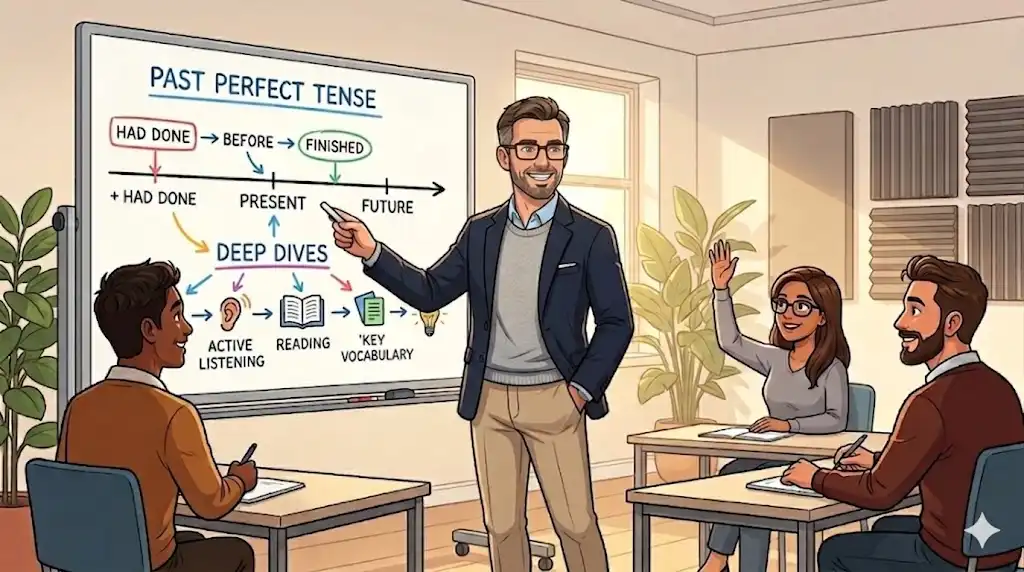
    Welcome to this, the first intermediate Deep Dive from Linguacade. I’m excited about the grammar that we are going to explore today because many of my students find it difficult to understand exactly how to use the Past Perfect Tense, and I am sure that this session will help you develop confidence in using it.

    I’m going to introduce two words today, and show you how they trigger the Past Perfect Tense in English. The verb ‘to trigger’ means ‘to make something happen’.

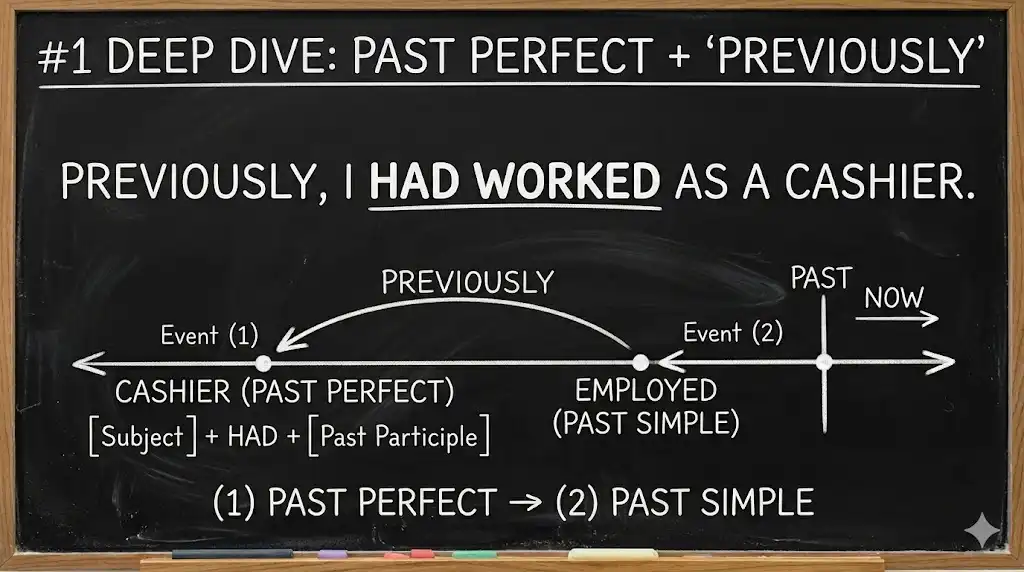
    The two words ‘previously’ and ‘before’, both trigger the Past Perfect Tense. The words ‘previously’ and ‘before’ are interchangeable. This means that they mean the same thing, which is, ‘at a time before this moment’ or ‘at a time before that moment’. Let’s look first at ‘previously’ with this example from Intermediate episode 1 ‘Meet your teacher’:

    ‘The principal must have been pretty desperate because she chose to employ me as a part-time teacher of English anyway. Previously, I had worked as a cashier in a local shop and as a barman in a pub, so the opportunity to earn more money and do a more interesting job was quite a step up for me.’

    This episode is telling a story; the story of Jason’s career. In English, when we tell a story and say what happened in the past we use the Past Simple Tense when we are describing events in the order in which they happened. Here’s an example:

    ‘In 1991, Jason worked as a cashier in a local shop. Then he changed jobs and became a barman. He did this until spring 1992. Then, in summer 1992, Jason’s mother asked her boss, the principal, to consider employing Jason at the language school. The principal was desperate so she decided to employ Jason. He accepted the job and he started working at the language school in summer 1992.’

    These sentences tell a story in the Past Simple Tense. You will notice that the events in this version of the story happen one after the other, in the correct date order (which we describe as ‘chronological’ order). Because every event is in its correct place, in date and time order, we use the Past Simple Tense for every verb. This is a very important rule to understand in English grammar; if you tell a story and you list the events in the order that they happened, from the first event to the last event, then you should use only the Past Simple Tense. This is a little bit like saying, ‘First, second, third, finally.’

    However, when we tell a story in the Past Simple Tense but we introduce an event that is out of sequence, because it happened before an event that has already been mentioned in the story, then we often use the word ‘previously’ followed by the Past Perfect Tense. This is a little bit like saying ‘Second, third, (previously) first, finally’.

    Let’s examine how that works. First, let’s look at the correct, chronological order of the events:

    (1) Jason worked as a cashier and then he worked as a barman

    (2) The principal was desperate so she employed Jason

    However, in my story, I change the sequence of the events:

    (2) ‘The principal must have been pretty desperate because she chose to employ me as a part-time teacher of English anyway. (1) Previously, I had worked as a cashier in a local shop and as a barman in a pub, so the opportunity to earn more money and do a more interesting job was quite a step up for me.’

    Here, I am providing information that is out of sequence because it happened before something else, so I use the word ‘previously’, which means ‘before that time’. Then I use the Past Perfect Tense. This is an easy tense to form, because it is made with the subject (I, you, he, she, it, we, they) plus the Past Simple form of ‘have’, which is ‘had’ and finally the past participle, which is often called ‘Verb 3’ because it is verb number 3 in a table of verbs.

    Now, should you say ‘Previously I had worked’ or ‘Previously I’d worked’? Students often ask me when they should contract phrases and use the short form and my answer is very simple. When you don’t want to emphasise a phrase or a part of a sentence, then you should contract it and use the short form. When you do want to emphasise that part of the sentence, you should use the uncontracted long form. You might want to pronounce the contracted forms to check them.

    I had = I’d, you had = you’d, he had = he’d, it had = it’d, we had = we’d, they had = they’d

    Here are some more examples. Some of these are the contracted short forms and some of these are the uncontracted long forms:

    ‘In 2023, Harry Kane moved to Bayern Munich. Previously, he had played for Tottenham Hotspur.’ (The uncontracted long form ‘he had’ gives a little focus and emphasis to his previous job at Tottenham Hotspur).

    ‘Last year we went to Paris for the summer whereas previously, we’d always been to London.’ (The contracted short-form ‘we’d’ shows that this Past Perfect phrase is not a particular emphasis of the sentence).

    Now let’s look at the Past Perfect used with ‘before’. Here’s our first phrase:

    Before starting university, I had not studied Spanish.

    Let’s examine how that works by looking at the correct, chronological order of the events:

    (1) Jason didn’t study Spanish.

    (2) Jason went to university and started studying Spanish.

    Here are two other examples from the episode:

    ‘The advanced group was made up of students who had studied Spanish at school…

    (1) Some students studied Spanish at school.

    (2) Those students joined the advanced group at university.

    ‘…and the beginner group was made up of students who had never studied Spanish before.’

    (1) Some students didn’t study Spanish.

    (2) Those students joined the beginner group at university.

    In all of these sentences the order of the events is not in sequence, so we must use the Past Perfect Tense to communicate that the second event mentioned actually happened before the first event.

    Now, it would technically be possible to avoid using the Past Perfect Tense and, instead, to tell the story with the events in the correct order, using only the Past Simple Tense. Listen to how this would sound:

    Some students studied Spanish at school and they made up the advanced group, but some students did not study Spanish at school and they made up the beginner group.

    While this is technically possible, it does not sound good in English. In fact, it sounds forced, heavy and unnatural. The reason for this is because every activity in the sentence has equal importance. I don’t want every activity and event in the sentence to have equal importance. I want my listeners to know that what happened before university was a less important detail.

    Let’s look again at how the sentence was phrased in the Intermediate podcast episode 1:

    ‘The advanced group was made up of students who had studied Spanish at school and the beginner group was made up of students who had never studied Spanish before.’

    I have said that the Past Perfect Tense is used to refer to a past event that is not in the correct sequence, but there are two other important reasons for using the Past Perfect Tense in this kind of phrase.

    The first reason is because the focus of the story is the experience at Cardiff University, not the experience that students had at school. I’m not so interested in what the students did at school and I don’t want to make it my focus in the sentence. I only want to refer back to what had happened before university to provide some context or extra information. If I avoid the Past Perfect Tense and only use the Past Simple Tense I must list the events in the order that they happened (first, second, third, finally). If I do this then school – not university – becomes the main focus of the sentence, thus:

    ‘Some students studied Spanish at school and they made up the advanced group, but some students did not study Spanish at school and they made up the beginner group.’

    Can you hear that, in this heavy and unnatural sentence, the focus is on school, not university? I don’t want that, so the sentence in the story uses the Past Simple Tense for the important parts of the sentence and Past Perfect Tense for the details that had happened before, and which affected the composition of the two Spanish groups; beginner and advanced.

    One easy way to understand how to use ‘previously’ and ‘before’ with the Past Perfect Tense is to imagine taking a photo. When you take a photo you choose the object that is the focus of your picture. You aim your camera at the image that is important to you, for example a person. This person is in the foreground, or the centre. However, there are usually other objects in your picture. Behind the person there may be scenery and other objects that are not central, but that give context to your photo. For example, I may take a picture of a friend sitting in a café. The friend is in the foreground of the picture but, in the background, there is visual information telling me that this friend is in a café. The background information provides context, but it is not the main focus of the photo. This is exactly the case with a phrase in the Past Perfect Tense, which is the ‘background’ and ‘extra context’ of my sentence, whereas the Past Simple Tense highlights the ‘foreground’ and the ‘main focus’ of my sentence.

    I like this idea because the ‘background’ elements in a photo are behind the ‘foreground’ elements. This helps us to remember that the Past Perfect Tense is used to describe a past tense behind another past tense.

    This brings me to the second reason for using the Past Perfect Tense with ‘previously’ and ‘before’. Often, when people are telling a story in the Past Simple Tense, listing the events of the story in the correct, chronological, order, they remember an event, a detail, a piece of extra information or some background information that they want to add to the story, but it is something that happened before the events they have already mentioned. This is the perfect opportunity to use the Past Perfect Tense, because it allows the person to add some information out of sequence. Here’s an example:

    ‘Last summer we flew to Cairo and visited the Pyramids. We also went to some amazing restaurants and ate Egyptian food, which we’d never tried previously’.

    In this sentence, the speaker is describing the events of the holiday, but then realises he would like to add some extra context, or background information, so he uses the Past Perfect Tense to do this. Notice, too, that the word ‘previously’ is now at the end of the sentence. It is, of course, possible to say ‘which, previously, we’d never tried’ but it sounds a little more natural to put ‘previously’ (or ‘before’) at the end of the phrase.

    It’s also important to note that there are a few other words that can be used to communicate ‘before’. I’ll list them all and explain their use.

    ‘Before that’ means exactly the same as ‘before’. This is an informal phrase and it is frequently used in spoken English. ‘Previously’ is more formal. It can certainly be used in conversation, but it is more frequently used in writing. ‘Prior to that’ is even more formal and is perfect to use in business letters and emails. Finally, we have ‘hitherto’. This is extremely formal and old-fashioned and not much used. If I said, ‘I had a hamburger at McDonalds yesterday but, hitherto, I had never eaten fast food,’ it would sound very strange. Nevertheless, people sometimes use ‘prior to that’ or ‘hitherto’ instead of ‘before that’, especially if they want to draw people’s attention to the phrase. The basic rule in English is that if you use a low-frequency (uncommon) formal word instead of the basic (common) word, it is because you want to draw very specific attention to the phrase, perhaps because you are being ironic or sarcastic.

    To finish this session, I would like to look at some of the other examples of the Past Perfect Tense that appear in episode 1.

    Sentence 1: ‘She (my mother) explained that, although I didn’t have the correct qualification to be an English teacher, I had completed my final school exams.

    This sentence contains an interesting comparison using the word ‘although’. It presents, in the Past Simple Tense, the idea that although something was true at a particular time (I didn’t have the correct qualification) there was an event or factor, presented in the Past Perfect Tense, that had previously taken place and that mitigated or affected the idea. Here’s another phrase containing this structure:

    ‘Although he spoke French well, he had never studied it at school.’

    ‘He had never studied French at school, although he spoke it well.’

    Sentence 2: ‘…they had already had seven years of Spanish experience from their school career before starting university.

    This is an interesting phrase because it contains the Past Perfect form (of) ‘had’. It is perfectly acceptable to say ‘I had had seven years of experience’ or ‘I had already had seven years of experience’. When we use the Past Perfect with the verb ‘to have’ it’s important to remember that ‘had’ means two different things in the phrase ‘I had had’. The first ‘had’ is the auxiliary form of ‘have’ but the second ‘had’ is the past participle. Very often, the first ‘had’ is contracted, so it would be normal to say ‘they’d already had seven years of Spanish experience’.

    You will notice too, that the second part of sentence 2 ‘before starting university’ contains the gerund ‘starting’ rather than the Past Simple ‘started’. Students often ask why the gerund is used in this case, when it might be clearer to say, ‘before they started university’. Although, ‘before they started university’ is technically possible, the words ‘before’, ‘while’ and ‘after’ are normally followed by the gerund (the -ing form) in English. Listen to these examples:

    ‘After finishing the course, he went to the USA’. This means the same as ‘After he finished the course, he went to the USA.’

    ‘He studied for his Law exam while working in a supermarket’. This means the same as ‘He studied for his Law exam while he was working in a supermarket’.

    ‘Before leaving the house he locked the door’. This means the same as ‘Before he left the house he locked the door’.

    Sentence 3: ‘Whereas French and Spanish had been relatively easy to learn, Finnish seemed impossible to me.

    In this sentence, we have the word ‘whereas’. This could be replaced with words such as ‘though’, ‘although’ and ‘despite the fact that’. You will notice that the first part of the phrase is in the Past Perfect Tense. Why? Well, it would be possible to say, ‘Whereas French and Spanish were relatively easy to learn, Finnish seemed impossible to me’. If both parts of the sentence are in the Past Simple Tense, they seem to have equal importance. However, I want my phrase to focus on how difficult Finnish was, so I have chosen to use the Past Perfect Tense for the first part of the sentence because I want to indicate that this part of the sentence is less important.

    Sentence 4: ‘After my test, the head interpreter said that I had done well.’

    This is a very simple use case for the Past Perfect Tense. The Past Simple Tense provides a point in the past with the verb ‘said’, but my performance in the test obviously happened before the head interpreter said anything. It would be incorrect, therefore, to say, ‘After my test, the head interpreter said that I did well’. As you will see later, English people often say this kind of phrase and use the Past Simple Tense incorrectly simply because they want to save time when speaking.

    Sentence 5: ‘Sue could come with me to Geneva and sacrifice the job offer that she had received from Nokia Networks.’

    In this sentence, the modal ‘could’ is used as the Past Simple Tense marker. The modal ‘could’ is used with the infinitive ‘come’ but it also refers to the infinitive ‘sacrifice’. It would be possible to say, ‘Sue could come with me to Geneva and could sacrifice the job offer that she had received from Nokia Networks’. However, repeating the word ‘could’ makes the sentence feel heavy. Here’s another example of how a modal is used once, when it actually refers to several infinitives:

    ‘The students could read, write and understand grammar even though they had never studied English formally.’

    Sentence 6: ‘…and Sue did not speak French, which is the language spoken in Geneva. What’s more, Sue had already sacrificed a year to be with me in Bath.’

    This is an interesting grammar point because the phrase containing the Past Perfect Tense stands alone in its own sentence. The reason the Past Perfect Tense is used here is because I want to emphasise the fact that, up until that moment in 1998, Sue had sacrificed a year of her time (from 1997 to 1998) before we had to make a decision about where to go next. The sentence simply implies that there had been a year of sacrifice before a decision needed to be made about what to do next.

    Sentence 7: ‘Just as my course director at Bath University had done in 1998, my old French teacher made a suggestion. He said, ‘Why don’t you become a secondary school teacher?’

    Here, the Past Perfect Tense is used so that I can recall the less important or ‘background’ fact that the course director at Bath University had made the same kind of suggestion many years before my French teacher. It would be possible and correct to say, ‘Just as my course director at Bath University did in 1998, my old French teacher made a suggestion.’ However when both parts of the phrase are in the Past Simple tense they seem to be of equal importance. Here, I want to make the French teacher’s suggestion the most important element, so I use the Past Simple ‘made’. You may remember, from earlier in this episode, how the Past Perfect Tense can be used to make phrases ‘background’ or ‘less important’ phrases. This use of the Past Perfect Tense provides a clear indication to the listener that I consider the previous suggestion from the course director at Bath University to be of secondary importance.

    Sentence 8: ‘Before leaving my secondary teaching job in July 2023, I had been reflecting on the start of my career and thinking about how wonderful it had been to have my own small company in Finland.

    Here, we have another example of ‘before’ followed by the gerund (-ing). I could also say, ‘Before I left my secondary teaching job’ but I would only use the Past Simple Tense after the word ‘before’ if I wanted to give it a little extra emphasis. Otherwise, I would always use the gerund, as this sounds more natural in conversation.

    This sentence also contains examples of the Past Perfect Continuous Tense in the phrase ‘I had been reflecting on the start of my career and thinking about how wonderful it had been to have my own company in Finland’. The Past Perfect Continuous Tense is not a particular focus of this Deep Dive, but it is used to define an activity in the past that continued for a period of time before another activity. It would be perfectly possible for me to say, ‘Before leaving my secondary teaching job in July 2023, I had reflected on the start of my career and thought about how wonderful it had been to have my own small company in Finland’. However, if I use the Past Perfect Tense here, it communicates that ‘reflecting’ and ‘thinking’ were short, limited activities that did not continue over a period of time. I want to communicate that the ‘reflecting’ and the ‘thinking’ were ongoing activities continuing over time, until the moment that I left my secondary teaching job, so I use the Past Perfect Continuous here to emphasise the fact that these activities of reflecting and thinking continued until they were interrupted by the single activity of leaving the teaching job.

    Sentence 9: ‘I decided to do something that I had been intending to do for 30 years, which was, finally, to get a qualification as a teacher of English as a Second Language (ESL).’

    In this sentence, we have the Past Simple Tense marker ‘I decided’ in the first part of the sentence. This is followed by the Past Perfect Continuous phrase ‘something that I had been intending to do for 30 years’. I could use the Past Perfect tense here and say, ‘something that I had intended to do for 30 years’ but this would not communicate the intensity of the continued intention. As a general rule, we use the Past Perfect Continuous Tense when we want to draw attention to the fact that there was continuity and ongoing focus on a particular activity, from one moment in the past until another moment in the past, which is indicated by the Past Simple Tense. In this case, I want my listeners to focus on the fact that my intention to get the ESL qualification had been strong and I had often thought about it over a period of 30 years, until the moment when I actually obtained the qualification.

    Sentence 10: ‘It was poignant and perhaps a little ironic that the best course provider was the school where I had accidentally started my teaching career in 1992, more than 30 years previously.’

    In this sentence, we have the Past Simple Tense word ‘was’ followed by a Past Perfect Tense clause with the word ‘previously’. The reason for moving the word ‘previously’ to the end of the sentence is because I have already used the adverb ‘accidentally’ at the start of the phrase. It would sound awkward to say the two adverbs together, in a phrase such as, ‘the best course provider was the school where I had, 30 years previously, accidentally started my teaching career in 1992.’ This sentence sounds heavy and clumsy.

    Sentence 11: ‘For the next 2 years, from January 2024 to January 2026, I had many incredible times. It felt absolutely right and fitting to be back where I had started.

    The only important thing to note in this sentence is the fact that many people whose first language is English would not automatically use the Past Perfect Tense here and would instead substitute it with the Past Simple. I have often heard native English speakers saying phrases such as, ‘It felt absolutely right and fitting to be back where I started’. Is this technically correct? No, because the starting point was in 1992, long before 2024. However, I mention this because – as I’m sure you probably know – English people frequently make all kinds of mistakes in their speaking and writing. It can feel confusing to learn about the Past Perfect Tense and then hear English people avoiding it, when they really should use it. The key thing is to recognise that most English native speakers often haven’t studied their own grammar formally. If you hear the Past Simple Tense used when you know that the Past Perfect Tense should be used, it is usually done subconsciously to save time when speaking.

    Sentence 12: ‘I began thinking seriously about how, when I was studying other languages, I had benefitted from the kindness of other teachers who had created free podcasts and given away free resources.

    I have included this final sentence because it has a clause (or section) between the Past Simple Tense phrase and the Past Perfect Tense phrase. The extra phrase, ‘when I was studying other languages’ is in the Past Continuous Tense. It provides extra context and is separated by commas, so it could be removed completely without changing the basic meaning of the sentence. Therefore, I could say, ‘I began thinking seriously about how I had benefitted from the kindness of other teachers who had created free podcasts and given away free resources.’

    Thank you for joining me on this journey through the Past Perfect Tense. If you’ve enjoyed this first Deep Dive, please consider subscribing to the Linguacade Patreon community to get full access to all Deep Dives for all levels. I’ll see you next time!

    Join the Linguacade Patreon community to unlock full transcripts and audio for all levels (£4/month for total access)

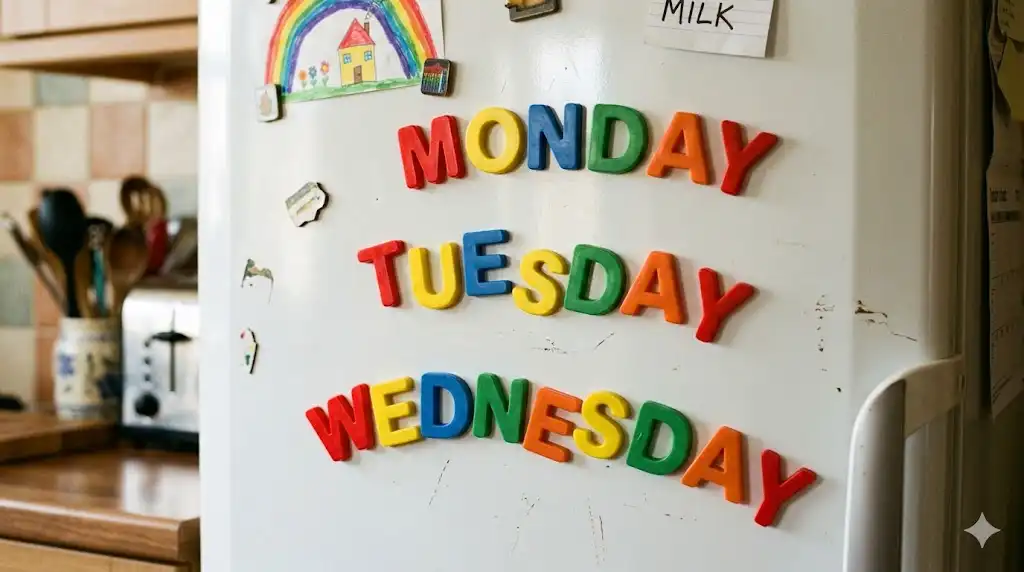
  • 2 The alphabet, spelling and days (A1)

    2 The alphabet, spelling and days (A1)

    Hello! How are you? This is Jason. I’m happy to be with you today. How are you doing? I’m doing fine! It’s nice to work with you again.

    Today we are going to study the alphabet in English. This is the long form.

    Today we’re going to study the alphabet in English. This is the short form.

    Today we’re gonna study the alphabet in English. This is the very short form. It is also very informal.

    We’re gonna’ is the same as ‘we are going to’ and ‘we’re going to’. It’s not good-quality English, but I’m teaching it because it is what people often say. If people often say certain words, then these words are called high-frequency words. ‘Gonna’ is a high-frequency word.

    What is the alphabet? The English alphabet has 26 (twenty-six) letters. There are 21 (twenty-one) consonants and five vowels in the alphabet.

    Listen to the letters of the alphabet and repeat them after me:

    Aa, Bb, Cc, Dd, Ee, Ff, Gg, Hh, Ii, Jj, Kk, Ll, Mm, Nn, Oo, Pp, Qq, Rr, Ss, Tt, Uu, Vv, Ww, Xx, Yy, Zz

    In American English, people say ‘zee’ instead of ‘zed’ (Zz).

    Each letter has two forms. The big letters at the start of a sentence or phrase are called capital letters and the small letters are called lower-case letters.

    There are 5 vowels in the alphabet. They are: Aa, Ee, Ii, Oo, and Uu.

    In English, we use the verb ‘to spell’ to say the letters in words and names, in the correct order. Listen to these conversations:

    Hello, I am Jason. Jason is spelled J-A-S-O-N. This is the long form.

    Hi, I’m Jason. It’s spelt J-A-S-O-N. This is the short form.

    Listen to these phrases. They all have the same meaning. They all mean the same thing:

    My name is Jason. It is spelled J-A-S-O-N. My surname is Garner. It is spelled G-A-R-N-E-R.

    My first name is Jason. It’s spelt J-A-S-O-N. My last name is Garner. It’s spelt G-A-R-N-E-R.

    My name’s Jason and it’s spelt J-A-S-O-N. My family name’s Garner and it’s spelt G-A-R-N-E-R.

    Your ‘name’ can also be your ‘first name’. They are the same thing. Your ‘surname’ can also be your ‘last name’ or your ‘family name’. They are the same thing.

    In English, a person may use long sentences or short sentences to introduce themselves and say their name. Listen to these sentences. The first sentences are long and the last sentences are short:

    My first name is Tom and my surname is Smith. This is the long form.

    My name’s Tom and my surname’s Smith. This is the short form because ‘my name’s’ means ‘my name is’.

    My name’s Tom and my family name’s Smith.

    My name’s Tom and my last name’s Smith.

    All of these sentences are good and correct.

    Now listen to this long-form conversation:

    Hello! What is your name?

    My name is Tom.

    How do you spell Tom?

    It is spelled T-O-M.

    And what is your surname?

    My surname is Smith.

    How do you spell Smith?

    It is spelled S-M-I-T-H.

    Now listen to this short-form conversation. It means the same as the previous conversation, but it is shorter. English people normally use the short forms when they speak:

    Hi! What’s your name?

    My name’s Tom.

    How do you spell Tom?

    It’s spelt T-O-M.

    And what’s your last name?

    My last name’s Smith.

    How do you spell Smith?

    It’s spelt S-M-I-T-H.

    Now listen to this conversation:

    My name’s David Rogers and I live in Birmingham.

    Can you spell David, please?

    Sure, it’s D-A-V-I-D.

    And can you spell Rogers, please?

    Certainly. It’s R-O-G-E-R-S.

    I’m sorry, can you repeat that please?

    No problem. It’s R-O-G-E-R-S.

    Thanks, I got it that time.

    Do you live in Bristol, David?

    No, I’m from Birmingham and I live there.

    How do you spell Birmingham?

    It’s spelt B-I-R-M-I-N-G-H-A-M.

    I didn’t understand that. Could you repeat it please?

    Okay. No worries! It’s B-I-R-M-I-N-G-H-A-M.

    If you want to know how to spell a word or a name you must ask a question. Here are some questions that you can ask:

    Could you spell that for me please?

    Can you spell that please?

    How do you spell that?

    How do you spell it?

    How’s that spelt?

    How’s it spelt?

    You can see that there are many ways to ask the same question because these questions all mean the same thing. If something ‘means the same thing’ it is not different. It is the same.

    Now listen to these phrases:

    I’m sorry, I didn’t understand that. Could you repeat it, please?

    I’m sorry, could you repeat that for me, please?

    Sorry, can you repeat that, please?

    Can you repeat that?

    You can see that there are also many ways to ask someone to repeat something again.

    ***

    Now we’re going to look at the days in the week.

    There are 7 days in a week. A day is a period of 24 (twenty-four) hours. Listen to the days and say them after me:

    Monday, Tuesday, Wednesday, Thursday, Friday, Saturday, Sunday.

    Can you see that the days all start with a capital letter? This is important. When you write the days, you must write them with a capital letter. Remember that a capital letter is a big letter and a lower-case letter is a small letter.

    Monday is the first day of the week. The ‘first day’ means ‘day number one’.

    Tuesday is the second day of the week. The ‘second day’ means ‘day number two’.

    Wednesday is the third day of the week. The ‘third day’ means ‘day number three’.

    Thursday is the fourth day of the week. The ‘fourth day’ means ‘day number four’.

    Friday is the fifth day of the week. The ‘fifth day’ means ‘day number five’.

    Saturday is the sixth day of the week. The ‘sixth day’ means ‘day number six’.

    Sunday is the seventh day of the week. The ‘seventh day’ means ‘day number seven’.

    Now listen to these phrases:

    What is the first day of the week?

    The first day of the week is Monday.

    What does ‘first’ mean?

    ‘First’ means ‘number one’.

    How do you spell Monday?

    It’s spelt M-O-N-D-A-Y

    What’s the fifth day of the week?

    The fifth day of the week is Friday

    What does ‘fifth’ mean?

    ‘Fifth’ means ‘number five’.

    How do you spell Friday?

    It’s spelt F-R-I-D-A-Y

    Saturday is the sixth day of the week and Sunday is the seventh day of the week. The two days Saturday and Sunday are called the weekend.

    To finish this lesson, let’s look at the verb ‘to mean’. It’s very important for asking questions and clarifying in English. ‘Clarifying’ means ‘checking’.

    Listen to these phrases:

    What does ‘Tuesday’ mean?

    Tuesday is the second day of the week.

    What does ‘gonna’ mean?

    Gonna’ means ‘going to’. It’s a very short form. It’s very informal.

    I’m going to study on Monday.

    What do you mean?

    I mean that I’m going to read and listen to podcasts.

    In English you must say, ‘What does … mean?’ (… = dot, dot, dot) You must not say ‘What means…?’ (… = dot, dot, dot) This is wrong. Please don’t say ‘What means…?’ (… = dot, dot, dot) . It’s not good English.

    Listen to this incorrect, wrong and bad phrase:

    ‘What means ‘Monday’?’

    No! This is wrong. It is bad English. You must not say ‘What means…?’ (… = dot, dot, dot).

    Now listen to this correct, right and good phrase:

    What does ‘Monday’ mean?

    Yes! This is right. It is good English. You must say ‘What does … mean? (… = dot, dot, dot).

    Let’s finish with several phrases that contain the correct, right and good structure:

    What does ‘Saturday’ mean?

    Saturday is the sixth day, but it is the first day of the weekend.

    What does ‘phrase’ mean?

    A phrase is a sentence.

    What does ‘vowel’ mean?

    A vowel is one of these letters: Aa, Ee, Ii, Oo or Uu.

    This is the end of the lesson. Thank you for listening. Please go to linguacade.com to get the free transcripts for all my lessons.

    Unlock the Deep Dive: If you enjoyed this lesson, join the Linguacade Patreon for just £4/month. Get instant access to exclusive masterclasses covering every highlighted word and phrase in the Beginner, Intermediate, and Advanced episodes.

  • BDD 2 Agreeing, repeating and ‘going to’ (A1)

    BDD 2 Agreeing, repeating and ‘going to’ (A1)

    Hello! Thank you for joining me on this Deep Dive. Today we’re going to look at some important words and phrases from the Beginner podcast episode 2.

    Listen to these phrases:

    Today, we are going to study agreeing and repeating. This is the long form.

    Today, we’re going to study agreeing and repeating. This is the short form.

    Today, we’re gonna study agreeing and repeating. This is the short form. It is also very informal.

    ‘Going to’ means the same as ‘gonna’. ‘Going to’ is the long and polite form. ‘Gonna’ is the short and informal form. You can say ‘gonna’ but you must not write it. Instead, you must always write ‘going to’.

    What does ‘I am going to study’ mean? It means ‘I have decided to study in the future’. The words ‘going to’ are used for a decision that you have already made, before you speak, to do something in the future.

    Listen to this long-form conversation:

    What are you going to do this week?

    On Monday and Tuesday, I am going to work and on Wednesday and Thursday, I am going to study. On Friday, I am going to listen to music and on Saturday and Sunday, I am going to relax.

    Now listen to this short-form conversation:

    What are you gonna do this week?

    On Monday and Tuesday I’m gonna work and on Wednesday and Thursday I’m gonna study. On Friday I’m gonna listen to music and on Saturday and Sunday I’m gonna relax.

    Remember, this short form ‘gonna’ is only for speaking. You must not write it.

    Here are the long forms of ‘going to’:

    I am going to, you are going to, he is going to, she is going to, it is going to, we are going to, they are going to.

    Here are the shorter forms of ‘going to’:

    I’m going to, you’re going to, he’s going to, she’s going to, it’s going to, we’re going to, they’re going to.

    Here are the very short and informal forms of ‘going to’:

    I’m gonna, you’re gonna, he’s gonna, she’s gonna, it’s gonna, we’re gonna, they’re gonna.

    It’s important to learn these very short forms of ‘going to’, because you will hear them many, many times in English. They are not ‘perfect’ English, but they are very high-frequency English.

    Here are the long question forms of ‘going to’:

    Am I going to? Are you going to? Is he going to? Is she going to? Is it going to? Are we going to? Are they going to?

    And, finally, here are the short, informal question forms of ‘going to’:

    Am I gonna? Are you gonna? Is he gonna? Is she gonna? Is it gonna? Are we gonna? Are they gonna?

    This is the way to use ‘going to’:

    The verb ‘be’ (for example, ‘I am’) + (plus) the words ‘going to’ or ‘gonna’ + (plus) a verb (for example, ‘work’)

    I am + going to + work, or I’m + gonna + work.

    Listen to these sentences with examples of ‘going to’ in different forms:

    I’m not gonna work on Saturday. I’m gonna relax.

    Is he going to listen to music?

    They live in Saudi Arabia now, but they’re going to live in London next year.

    We’re going to study on Wednesday.

    Are you gonna listen to the Linguacade podcast?

    Is she going to study English?

    ***

    In this part of the lesson, we’re going to look at agreeing and repeating. First, let’s remember some words and phrases for agreeing. Listen to them and say them after me:

    Okay! Yes! Sure! Certainly! No problem! No worries!

    To ‘agree’ is to say ‘yes’ with different words. For example, ‘okay’, ‘sure’, ‘certainly’, ‘no problem’, and ‘no worries’ all mean ‘yes’. These agreeing words and phrases are very high frequency in English. This means that they are very common and normal.

    Now let’s remember some phrases for repeating:

    I’m sorry, could you repeat that for me, please?

    Sorry, I didn’t understand that. Could you repeat it?

    Sorry, can you repeat that, please?

    Can you repeat that?

    To ‘repeat’ means to say something again, or to say something another time.

    You can change these phrases a lot. Listen to these examples:

    Can you repeat that?

    Can you repeat that, please?

    Could you repeat that?

    Could you repeat that, please?

    I’m sorry, can you repeat that?

    I’m sorry, can you repeat that, please?

    I’m sorry, could you repeat that?

    I’m sorry, could you repeat that, please?

    I’m sorry, I didn’t understand. Can you repeat that?

    I’m sorry, I didn’t understand. Can you repeat that, please?

    I’m sorry, I didn’t understand. Could you repeat that?

    I’m sorry, I didn’t understand. Could you repeat that, please?

    In these phrases ‘I’m sorry’ means ‘Excuse me’ or ‘Listen to me’. It’s a polite phrase. English people say ‘I’m sorry’ all the time. Are they sorry? No, they are not sorry. ‘I’m sorry’ can mean ‘I feel bad about this’. But, if you hear someone say ‘I’m sorry’ it means the same as ‘Excuse me’ or ‘Listen to me’. English people also use the short form ‘sorry’. Listen to these phrases:

    Sorry, I didn’t understand.

    Sorry, I’m not gonna listen.

    Sorry, my name’s Dave, not David.

    Sorry, could you repeat that, please?

    Now let’s listen to agreeing and repeating phrases in some sentences:

    Hello, I’m Michael.

    I’m sorry, could you repeat that, please?

    Sure, no worries! I’m Michael.

    How do you spell that?

    It’s M-I-C-H-A-E-L.

    I’m sorry, I didn’t understand. Can you repeat that?

    Okay, no problem! It’s M-I-C-H-A-E-L.

    What are you going to do on Saturday?

    I’m going to watch TV.

    I’m sorry, I didn’t understand. What does ‘watch TV’ mean?

    No worries! Okay, ‘watch TV’ means watch a movie or a series.

    Thanks. How do you spell ‘watch’?

    It’s spelt W-A-T-C-H.

    I’m sorry, I didn’t understand. Can you repeat that?

    Sure! It’s spelt W-A-T-C-H.

    Okay, I got it that time.

    Did you hear the phrase ‘I got it that time’? It means ‘now I understand’.

    This is the end of the episode. Thank you for listening to this Deep Dive! I’ll see you next time.

    Join the Linguacade Patreon community to unlock full transcripts and audio for all levels (£4/month for total access)

  • 2 Do you have any regrets in life? (B2)

    2 Do you have any regrets in life? (B2)

    Have you lived long enough to have any big regrets? A regret is a feeling of sadness, disappointment, frustration, or sorrow about something that has happened in the past and that cannot be changed now, because it’s too late. If I’m being completely honest with myself, I must admit that I do have several specific regrets about my past decisions. You will notice that I use the word ‘decisions’, and this seems to communicate that I ‘decided’ to be a certain way or that I ‘decided’ to do certain things. In reality, I didn’t actually ‘decide’ anything actively. The truth is that, for many years, I wasn’t really thinking about what I was doing in certain areas of my life. Because I wasn’t thinking actively and consciously about some things, I found myself making decisions and choices about those things passively and subconsciously. You could say that I was on a kind of ‘autopilot’ whereby I ‘defaulted’ to behaving in a certain way. These default behaviours became default patterns and the default patterns became lifestyle choices over a number of years.

    There is a very clear difference here: the things in my life that were successful, exciting and dynamic were usually deliberate decisions that I made actively and consciously, but the things that I regret were either (1) automatic and unthinking decisions that I made passively and subconsciously or (2) decisions to delay making a decision until later. As you will see, not making a decision or delaying a decision had dramatic consequences later in my life when I discovered that being passive and doing nothing to change certain aspects of my behaviour had a huge cumulative impact on my life over a period of many years.

    I’d like to look at some of my biggest regrets and ask you, do you also regret the same things?

    Firstly, I regret living in fear of other people. To live in fear of other people is to be afraid of what they think of you. I wish I hadn’t worried so much about what other people thought of me. I never woke up in the morning actively and consciously thinking, ‘Today, I want to be more afraid of other people,’ or ‘Today it’s my intention to worry about what people think of me.’ Of course, that never happened. Instead, I had a mindset and an attitude that caused me to worry in many little daily situations. When I found myself in a situation where I had the choice to be confident and unafraid or worried and afraid, I usually allowed myself to be worried and afraid. It just happened by default without me thinking much about it at all. I allowed it to happen again and again until it became a completely natural part of my life.

    The reason that my number one regret is my daily choice, over many years, to live in fear of others is because it caused several other regrets, which are all interconnected. My second regret is that I wanted to be liked by people. If only I hadn’t wanted to be liked by everyone. Do you see that living in fear of people’s opinions and wanting to be liked by people are actually very similar regrets? In some respects, they are two sides of the same coin. If that coin has a name, it is ‘fear of rejection’. To be rejected is to be dismissed or written off as unacceptable, inadequate or simply not good enough. I didn’t ever want to be in a situation where the people around me rejected me. I wanted people to like me and I wanted people to think good things about me. However, I never woke up in the morning thinking, ‘Today I want to be a people pleaser,’ or ‘Today I must do everything possible to ensure that people always think positive things about me.’ If I had thought actively in that way, perhaps I would have realised how very foolish my attitude was. But I didn’t think actively. Instead, when I found myself in a situation where I felt under pressure to please someone – especially an authority figure, an influential person, or a boss – I usually decided to please them, even if it had consequences for me and my family.

    Before I go any further, I would like to clarify that there is an enormous difference between, on the one hand, deliberately and consciously deciding to act in kindness because you simply want to bless and help someone and, on the other hand, passively and subconsciously deciding to do something for someone because you are afraid of them or the potential consequences if you don’t do that thing. These approaches are the opposite of each other and they are motivated by entirely different attitudes. I think it is incredibly important to see the difference. If you purposefully choose to act in kindness or do a service for someone because you want to bless them without caring whether or not they acknowledge your kind deed, or even whether or not they like you, then this is motivated by courage, freedom and love. If you passively and grudgingly choose to help someone, even when you don’t want to, because you are afraid of the consequences and worry about your reputation, then this is motivated by fear.

    So, if my first two regrets were both connected to a fear of being rejected by the people in my life, I think you can probably imagine what my other big regrets are. My third regret is the decision I made to give too much time and energy to my career. I wish I hadn’t given so much to my job. When I worked as a teacher in a secondary school, I chose to go into school early in the mornings and come home late. I sometimes chose to work during the holidays. I wasn’t paid any extra money for the overtime work that I did and I didn’t enjoy doing it either. So why did I do it? I did it because I was afraid of what some of my colleagues and line managers might think about me. You can see that there is a direct connection between my overwork and my fear of being rejected. If I hadn’t been so concerned about people’s opinions, I would have worked less and gone home earlier.

    My fourth regret is also connected to the other three. It is, perhaps, the biggest cause of sadness in my life. If only I had spent more time with my children. Not only that, but I also wish that I’d been more patient and loving towards them when they were young. Here is a very strange fact. I dedicated a lot of time and energy to doing things for people who were not my family or friends and who are no longer in my life. My choices to serve those people often directly prevented me from dedicating time and energy to my children who are my family and who are still very much in my life. In the past, I never woke up in the morning thinking, ‘Today I am going to prioritise people who are not my friends or family and who probably don’t care very much for me’. Nor did I ever think, ‘Today, I’m going to make sure that my children are my lowest priority,’ or, ‘Today, instead of courageously challenging people who try to take advantage of me, I’m going to do exactly what they ask without complaining but then project my guilt and frustration onto my children by getting angry with them when they want my attention, just because they would like to spend some more time with me.’ Obviously, I never thought like that, but I did behave that way.

    I think you can see the pattern here. A fear of rejection led me to be a people pleaser, which led me to work too hard, which led me to spend too little time with my children. We call this a domino effect. Dominoes are small rectangular blocks that can be placed close to one another upright in lines. When the first domino is knocked down, it falls against the next domino in the line and that one is knocked down too. Each domino falls against the next domino until all of the dominoes have been knocked down. So, a domino effect is a situation in which one problem creates another problem and then another and another.

    What should I have done to prevent this domino effect? Many years ago, when these regrets were daily lifestyle choices and patterns of behaviour, I could have done something about them. If only I had. The problem was that I was not actively thinking about the causes and long-term consequences of the frustrations that I had. I also believed that I was powerless to change the situations that frustrated me and that I had no control over them. That is ridiculous. I did have agency in those situations; I simply chose not to focus on my thoughts and analyse them. ‘Agency’ means the capacity, freedom and the power to do something.

    Now, it seems very easy and uncomplicated to see the solutions that I could not see when I was younger. There’s a saying in English: ‘Hindsight is a wonderful thing, but foresight is better’. Hindsight is the ability to see clearly things that are in the past and foresight is the ability to see things that are likely to happen in the future. The saying ‘Hindsight is a wonderful thing, but foresight is better’ therefore means that it is great to be able to identify a problem after it has happened, so that you can learn from the mistake you made, but it is even better if you can identify the problem before it happens. That way, you can prevent it from happening in the first place.

    So, what could I have done differently?

    I believe that I should have faced, listened to, analysed and dealt with my feelings. In the past, when I felt negative feelings such as anger, frustration, disappointment or sadness, I often accepted those feelings and allowed them to affect me. I wish I had chosen to face, listen to, analyse and deal with my feelings. Let’s look at the order of those actions. To face something is to make a deliberate decision to look directly at something and recognise it. Another synonym for ‘face’ is ‘acknowledge’. To acknowledge something is to recognise it and accept its existence. How could I listen to my feelings unless I had first recognised and acknowledged them? And how could I analyse them unless I had listened carefully to them? Only by facing, listening to and analysing those negative feelings would it be possible to deal with them. To deal with something is to resolve it. A resolution is a solution that I have decided to commit to completing.

    Allow me to give an example. Perhaps this example will resonate with you. Imagine this scenario: I went to a staff meeting at work in which a senior colleague asked me and the other teachers in the meeting to do some extra work. It was clear that the extra work would be time-consuming and difficult and would require many hours of commitment. Nobody warned me that this request to do extra work would come up at the meeting. It was an unpleasant surprise and it happened very quickly; so quickly, in fact, that I did not have time to process it. None of the other teachers challenged the request. After the meeting, I got into my car and drove home feeling angry and frustrated. By the time I arrived home, my feelings of frustration had turned into resentment. I externalised that resentment by being bad-tempered with my family. The children, who had not seen me all day, just wanted to spend a little time with me, but I was distant and grumpy. After dinner, still feeling resentful, I went into my office and started doing the extra work that I had been asked to do. At no point did I face, listen to, analyse or deal with my emotions. I just ignored and buried them, and then grudgingly started the work.

    The first thing to do would be to stop and face the feelings. What exactly were they? Could I name them? In this first stage I would probably identify and name anger, frustration, helplessness, injustice and disappointment. I would write these words down on a piece of paper, in any order, as they came to mind.

    The second thing to do would be to listen to those feelings. Which one was the strongest? Could I separate and rank the feelings in some kind of order from the strongest to the weakest? In order to listen to the feelings, I would probably need to go to a quiet place without distractions where I could be alone and speak aloud each word that I had written on the piece of paper. For me, listening to my feelings is the same as being curious about my feelings. When I say aloud the word ‘frustration’, I choose to be curious and interested in that frustration. If I listen by being curious and interested in the feeling of frustration, it helps me to understand that the feeling is not me. I am not the feeling. The feeling is something separate that has come into my reality and affected me. So, listening to my feelings helps me to see that I am distinct from them. They do not own me. This helps me to be calm and kind to myself and to see that, by naming and separating myself from the negative feelings, I create distance between myself and those feelings. If there is distance between myself and the feelings, I am already better placed to analyse them.

    The third thing to do would be to analyse those feelings. Why did I feel angry and why was anger the strongest feeling? At this stage, it can be hard to stay focused because the feelings can seem overwhelming, so I would tell myself, ‘I am not my anger. I am curious to know where this anger comes from’. If I could be patient with myself and not allow myself to be overwhelmed, I would probably analyse the following things: I was angry with the senior colleague for taking advantage of his position to ask the staff to do something unreasonable. Perhaps I was angry with him because he had done this before on several occasions. I was frustrated with the general situation, because this kind of thing had happened before and I had experience of how much time would be needed to complete the extra work. I was also frustrated with myself and the other members of staff for not having the courage to challenge the decision. I was also helpless, which meant that I felt I had no power to affect the situation. Perhaps I felt helpless because I was afraid of the consequences of questioning the decision. I felt injustice, too, because the senior colleague who had asked the staff to do the extra work had probably not thought about the many hours that each person would have to dedicate to completing the work. Fundamentally, the situation was not fair or right. Finally, I felt disappointed because I knew that accepting the extra work would affect my relationship with my wife and children and would embed and perpetuate a pattern of behaviour in myself that I did not like. Perhaps I also felt disappointed with myself for allowing fear of other people to control my actions.

    The fourth and final thing to do would be to deal with those feelings. When I say ‘deal with’, I mean ‘resolve’. As I have said previously, a resolution is a solution that I have decided to implement. For me, there are three parts to resolving the feelings. Part one is to consider what choices I actually have available to me in that situation. Part two is to allow myself to consider the absolute worst-case scenarios of making each choice. Part three is a commitment with myself to choose certain things, being certain of why I chose them and being at peace with myself about the resolutions I have decided to implement.

    The challenging situation about being asked to do extra work as a teacher was fairly typical but my approach to dealing with it was totally dysfunctional. I felt negative emotions. I allowed these feelings to control me and affect my behaviour without ever identifying or analysing them. I simply accepted the challenging situation and did the work. Nothing changed and nothing improved. Instead of becoming more resilient, more courageous and more confident, I became weaker, more cowardly and more uncertain.

    If I had actually considered my choices I would have felt empowered. To have choices is to have agency and power. But what could I have chosen to do? Well, there were a variety of choices with a variety of outcomes. Let’s consider them from the most extreme and visible to the most innocuous and invisible. Perhaps the most extreme choice would be to quit my job without another job to go to, or to start looking for another job that enabled a better work-life balance. Another extreme decision would be to email the senior leader and simply inform him that I refused to do the work. That would be a foolish and pointless decision and would create unnecessary problems for me. Alternatively, I could simply decide not to do the work without telling anyone, then wait and hope that nobody would notice. That would be a viable alternative if there was a real likelihood that no senior colleague would check I had completed the work, but not such a great alternative if it was certain that my work would be checked or if my input was part of a group project. If my work was certainly going to be seen or reviewed then I could have chosen to do it, but with a commitment to give it very low priority or to limit the number of hours I chose to dedicate to it. In this connection, I could also choose to give the work more time but instead cut out other jobs that I would normally do as part of my work remit. Finally, I had the choice not to allow any negative emotions to take up thinking space in my head.

    After considering my choices, I needed to allow myself to imagine and consider the absolute worst-case scenarios of making each choice. The term we use in English to describe thinking about the worst-case scenario is ‘to catastrophise’. It’s a verb that comes from the noun ‘catastrophe’, which means a terrible situation, a disaster or a calamity. It is not good to catastrophise unless we acknowledge and accept the unlikely future disaster calmly and resolutely as a possible outcome. If we look directly at the worst-case scenario and accept all that it may be, then it has much less power over us. I can confirm that this is true and I have the experience to prove it. Before deciding to quit my teaching job in 2023, I was terrified of what might happen; I catastrophised in a vague and general way about possible consequences. But when I decided to face those consequences directly, they lost a lot of their power. It was a relief to face the fear of not having enough money to pay the mortgage and the bills or even to lose our house. Once I had named the worst possible outcomes, I was able to be rational and see that even if we had no money and lost the house, there would still be options because we had family and friends who cared and who would not allow us to be destitute and live in the street.

    In my example about the meeting and the extra work, the worst-case scenarios were only as extreme as the decisions I made. If I chose to email the senior colleague and refuse to do the work, my job may have been in danger. If I chose to do the extra work but give it minimal time and minimum effort the worst-case scenario would probably have been slight disappointment from senior leadership about the quality of my work.

    If I had taken all the steps I have described above whenever I was put into a difficult or intractable situation at work, I would probably be a different person now. I would probably be less exhausted, more decisive and more able to support others. Looking at those steps makes it very easy to see that there were always practical and workable solutions through which I could have avoided a lot of stress and negativity.

    So, if I were placed in a similar situation now, what would I do? I would probably decide to do the work but give it as little time and energy as humanly possible. I would probably cut out other ‘necessary’ tasks that were part of my remit in order to save time that I could then spend with my family. Because I would have done the head work and thought everything through carefully, I would recognise that talking to the senior leaders was a pointless waste of time because, after all, they had chosen to implement the ‘extra work’ initiative without consulting the teachers, so why would they change their minds when faced with complaints? I wouldn’t be afraid of being criticised in a review because I would have made peace with myself that I was not overly concerned about what my line managers thought of me. Finally, every time I felt frustration, anger, disappointment, injustice, helplessness or any other negative feeling, I would take authority over the feeling and shut it down, refusing to allow myself to think about it and instead channelling the energy that I would have given the negativity towards finishing the task as quickly as possible.

    Earlier, I mentioned a saying in English: ‘Hindsight is a wonderful thing, but foresight is better’. Everything in the resolution process that I have just described relates to hindsight about things I wish I had done, but did not do, in the past. Yes, I have regrets about things that I can’t change now, but at least I face those regrets, accept them and own them. It was a lack of active, deliberate thinking that caused me to be passive and repeatedly make mistakes, which became lifestyle choices and then regrets. Now, however, I can harness those regrets and turn them into foresight.

    For example, nowadays whenever I have a strong negative feeling, I acknowledge to myself that something is wrong. I set aside time to sit down quietly with a pen and paper so that I can write down the name of the feeling, face it, listen to it, analyse it and deal with it. Because I know that my biggest regrets relate to fear of what other people think of me and my tendency, therefore, to be a people pleaser, I am especially careful not to make any decisions out of fear. I also recognise that the best solutions are those that create minimum friction and have few – if any – big consequences. I feel much happier about deliberately choosing certain paths and not others. I am much more deliberate about what I do.

    Unlock the Deep Dive: If you enjoyed this lesson, join the Linguacade Patreon for just £4/month. Get instant access to exclusive masterclasses covering every highlighted word and phrase in the Beginner, Intermediate, and Advanced episodes.

  • 2 The privilege of being Generation X (C2)

    2 The privilege of being Generation X (C2)

    In recent weeks, I’ve had a strange and impossible sum floating around in my head: 26 + 26 = 2026. Obviously, it’s not correct. Firstly, 26 + 26 = 52. Secondly, you can’t add two cardinal numbers together and then express them as the year ‘2026’. Please bear with me while I explain what these numbers mean and why they are so momentous for me. I was born in the year 1974. Between 1974 and 2000 there were 26 years. Between 2000 and 2026 there have been 26 years. So, there’s a kind of equilibrium – a state of supreme balance, if you will – in my life right now. At the time of writing this content, I’m 52 years old. I had exactly half of those years before the millennium and I’ve had the other half since.

    When I became aware of this symmetry of numbers in my life, I felt something akin to a sense of urgency. I wanted very badly to communicate both about what it feels like in 2026 to be Generation X (or, in short, a Gen Xer) and what it felt like before the millennium. I know what it was like to be around in the quieter times before the tech revolution and I also know what it’s like to be fully immersed in the cynical attention economy where uncontrolled algorithms run riot and people live in a semi-permanent state of panic borne out of endless, unavoidable comparison with those digital influencers who curate and publicise the veneer of a perfect life.

    There was a particular event in the year 2000 that gives real kudos to this symmetry of numbers in my life. It was in March 2000 that Mark Bush, from Essex, became the first person in the United Kingdom to have a broadband internet connection installed in his home. Now, you could argue that the tech revolution started long before the introduction of broadband internet but, from my perspective, it was the rollout of broadband from 2000 onwards that created the instant availability of information and the immediacy of connection with a global community that our brains love and hate in equal measure. I believe that 2000 was a watershed year. Before I got broadband, my only access to the World Wide Web was via a 56k dial-up connection that allowed me to download – at the very most – 50 kilobits of data per second (50 kbps). If I wanted to download a single 4-minute song from the internet it took more than ten minutes. And, even then, it was usually at the standard bitrate of 128 kilobits per second. What I’m trying to say is that, in the era of dial-up internet connections, things were very slow indeed. It took a long time to load the homepage of a newspaper and it took even longer to send an email with an attachment.

    When I reflect on the privilege of being a Gen Xer, it is because I conflate the word ‘privilege’ with the word ‘slowness’. I use the word ‘conflate’ deliberately. To conflate things means to combine two or more ideas or concepts into one, often mistakenly. In this connection it seems totally mistaken and counterintuitive to say that privilege somehow equates to slowness. Surely privilege is all about priority? It’s instant access, speed of entitlement, being first in line and suchlike. And yet, here I am saying that the privilege of being a Gen Xer is connected to the idea of slowness. But not slowness by choice; slowness by design. Slowness was imposed on us by the reality in which we lived. In the 1970s and 1980s there was much less choice. Things could only happen at a particular speed because the digital infrastructure did not exist to enable swift access. By way of example, John Hughes’s seminal teen movie The Breakfast Club was released in 1985 but I had to wait six years before it had its TV premiere. My cousin told me that it was going to be aired at 9pm on a Sunday night in 1991. I set a timer recording on the family’s Betamax video cassette recorder and went to bed. The following day I had my own copy, but it had been a very long time coming.

    Before I go any further down a road of exploring and celebrating slowness I want to make my intentions clear and explain exactly where I am taking this. I don’t want to romanticise or misremember anything about my childhood. I want to be brutally honest and objective about the frustration of having to wait for things that were, quite often, inaccessible in the moment. Believe me when I say that, as a child of the 80s, I was often incredibly frustrated about how inaccessible certain things were to me with my limited financial means and a lack of free digital infrastructure. What I do want to do, however, is fully accept the fact that – if I choose to stand back from my reality and observe it impassively and objectively – I have experienced an extraordinary reciprocal inversion in my 52 years of life. But what is a ‘reciprocal inversion’? I shall try to explain. When I was growing up, imposed and unavoidable slowness was considered bad; we didn’t want it. Now, in 2026, voluntary and deliberate slowness is very often seen as the pinnacle of a good and mindful life. By the same token, when I was growing up, speed and accessibility were eminently desirable; we wanted things fast. Now, in 2026, speed and accessibility in the digital sphere are often considered unhelpful, and even dangerous, for us. Because we can have things quickly and easily, with minimal friction, we don’t value them as we might if they were less available. Put simply, what we had back then we did not necessarily want. Now that we have what we thought we wanted, we realise that we don’t necessarily want it at all and – in some cases – we wish that we could once again live under the imposition of not having the choice.

    The more I reflect on this, the more I realise how very great a privilege it is to have been born in a year that placed me in this ‘sweet spot’ with 26 years of life on either side of the broadband revolution. I want to think actively, constructively and wisely about how I can live my life now in a way that remembers the past for what it truly was, without deceiving myself about how difficult and laborious it sometimes felt. I want to think honestly about how I can pull past memories of imposed inaccessibility into my present reality and recognise their value now in helping me to make good choices today.

    In my young life it was the imposition of slowness, inaccessibility or the lack of finances that first frustrated me and then – due to sheer boredom – pushed me to make choices to start activities that triggered slow dopamine and led to good outcomes. Now, in my middle-aged life, it is the fearful memory of an evening wasted on the instant dopamine hit of frictionless distraction from the infinite scroll of social media reels that I try – often unsuccessfully – to harness in order to make choices to start activities that will trigger slow dopamine and lead to good outcomes. In the past, the lack of choice motivated me to choose the right path. Now, it is the ubiquity of choice that prevents me from choosing the right path.

    How is this a ‘privilege’ or even a good thing? Wouldn’t it have been better for me never to have known what it was like to exist in a world where there was significantly reduced temptation to waste time? Well, yes and no. Living in that time enabled me to see that, due to circumstances beyond my control, I was forced to be considerably more patient and resilient than I am now. Although I’m embarrassed to say it, I must admit that I was, in some ways, a more focused and resilient person when I was 19 years old than I am now, at the age of 52. It is the symmetry of numbers in my life that enables me to see this in such clarity when it might not be so clear for someone born at a different time.

    I used the collocation ‘sweet spot’ to describe this time frame in which I have been alive. The sweet spot of a tennis racket is the spot in the centre that will give maximum power and return from a ball strike. Likewise, I exist in a sweet spot of experience. My grandparents, who were born in the Silent Generation, had no access to information technology. My parents, who are Baby Boomers, belong to a generation that has only had access to unlimited information at the end of their life. Most of the Baby Boomers I know struggle with technology or have lived long enough without it not to be affected by its pervasiveness. Millennials (or Gen Yers) have some understanding of what it was like to live in a world untroubled by social media, but even those born in 1981 would probably have had access to email by the time they were 15. Finally, Gen Z and Gen Alpha never knew a world without the internet. They are true digital natives.

    I am happy and grateful to sit in the sweet spot of these generational realities and be a true digital immigrant. I can remember the point in my life (at Cardiff University, in 1994) when writing emails took over from writing physical letters by hand, and I can remember when I had my first dial-up internet connection installed at my flat in Helsinki, Finland, in 1998. I can recall exactly how, when and why it became easier and more practical for me to use digital tools, rather than physical tools, for many of my day-to-day logistical tasks. But – and here I come to the crux of the problem – I can’t always recall how, when or why the concomitant, unhelpful digital distractions invaded my life. I have one particular memory of the moment when a family member persuaded me to join Facebook in 2007 but, apart from that, I don’t have any recollection of specific moments when I knowingly invited social media, short-form videos or online games to take up so much of my time. I am convinced that the reason for this is because the decisions to use digital tools for productivity were conscious but the decisions to allow myself to be distracted by social media were largely unconscious. Digital distractions are a creeping normality that has developed slowly and steadily over time. I didn’t invite them and I didn’t really want them. In fact, when I was using them, I tried actively not to think about the time that I was wasting. Denial prevented me from seeing the exponential increase in the time that I was throwing away.

    Allow me to return to this word ‘privilege’ again. I have said it is a privilege to be a Gen Xer and to have been actively involved in this digital revolution because it enables me to see the ‘before’ and the ‘after’. If I can have the courage and honesty to recall and accept both the benefits and difficulties of living in a pre-digital age then perhaps I can choose now to rekindle a level of personal discipline that would enable me to see, with a revitalised sense of surprise, the potential of the amazing digital tools that could help me to achieve so much more than I do currently. Perhaps seeing things with fresh eyes would also give me the motivation and strength to sidestep the unhelpful and destructive side of digital distractions. I can vaguely remember a time when the pedestrians I passed in the street were alert and aware of their surroundings. If the 19 year-old me were suddenly transplanted from 1993 to 2026, I think he would believe that people had collectively lost their mind, being willing to risk death by keeping their eyes fixed on a miniature screen, even when crossing the road in busy traffic.

    If I am truly to reawaken that sense of surprise and wonder I need to return to the past and remember some of the skills I wanted to acquire, which were sometimes so difficult to learn without computers or the internet. I must look unflinchingly at what was and what is in my own life so that I can take the good from the past and leverage it to discard the bad from the present. I must carefully and truthfully recall examples of what it was like so that I won’t distort the reality of what was not easy and then simply present the lazy cliché that everything was better because we didn’t have so many distractions.

    I’ll focus on two skills: learning jazz piano and picking up new languages.

    I tried to teach myself some jazz piano in my teenage years, but it was difficult. I didn’t have the money to pay for personal lessons so the only way to learn was to get teaching books from my local library. As I recall, the library did not have many books on jazz piano. The one book that I managed to get taught a system that did not sit well with my personal learning style. Whilst struggling through the book, I tried to listen to jazz, but it was hard to get hold of recordings. I had a cassette of the saxophonist Charlie Parker’s music but it was difficult to rewind and play his bebop licks without damaging the tape. Anyone who remembers cassettes will be all too familiar with how fragile they were and how easy it was to damage or destroy the magnetic tape by overplaying or by rewinding and playing the same section over and over again. I look back now and think of how limited my resources were and how so many doors to understanding jazz harmony were closed to me because the resources I needed were simply unavailable to me. If I compare that to my present-day reality, there are hundreds of free online courses teaching jazz piano to cater to every conceivable learning style. If I wanted to, I could simply visit YouTube for access to a complete set of graded video lessons that would lead me through every stage of learning from beginner to expert. It’s likely that between Spotify and YouTube, the entire back catalogue of every famous jazz pianist is instantly available for free. If my teenage self could see those resources, he would be amazed and he would most likely seize the opportunity to learn.

    Likewise, when I was first studying Spanish and Finnish, the only resources I had were ‘Teach Yourself’ books and an analogue radio that could pick up weak signals of national stations in those languages. It was frustrating trying to tune the radio manually; the speech was difficult to understand due to the signal interference and the broadcasts were clearly meant for native speakers, not students. Many of the programmes I listened to were utterly boring – certainly not the kind of content that I would choose to listen to now. There were no transcripts or subtitles and I could not pause the broadcasts. It wasn’t until 2001 that I got a DVD player and was able to choose manually the audio language and subtitles for a movie. It’s difficult to describe how mind blowing that was. As for the ‘Teach Yourself’ books, they were presented in such a way that the introductory chapters were dedicated to page after page of explanations on how to pronounce words. But, without any audio, it was almost impossible to learn the correct pronunciations. In my first year of university, I had one hour of Spanish conversation class a week, but even that was as part of a group of four students, so the actual experience of hearing and speaking Spanish was greatly reduced. It’s good for me to think back and reflect on those obstacles to learning and how I tried to overcome them. Now, if I want to learn a new language, there are limitless volumes of resources teaching every kind of content I could imagine. I can listen to the news in slow Swedish whilst reading the transcript of what I’m hearing. I can right click any word or phrase and instantly get the translation. I can use AI to create for me bespoke resources containing explanations and exercises on any grammar or vocabulary that I can think of. I can converse with AI on any subject and I can ask it to change its accent, diction and speed to suit my ability. I can listen to excellent podcasts recorded in beautiful quality and tailored to every level of learning and experience. All of these things are at my fingertips 24/7, yet I often fail to capitalise on them because I’m too tempted by frictionless distraction. My mind is so dizzy with the multiple contexts presented by the deluge of short-form videos I consume that I no longer have the resilience or the memory of slow dopamine joy to help me say ‘no’. I need to remember how hard it was to learn new skills and then leverage that memory to be more disciplined and determined now.

    There is one more thing that really needs to be said about those times before the internet: boredom was a big thing and not everyone used the feeling of boredom as a catalyst to motivate themselves to do something genuinely useful with their time. If you’ve seen a short-form video or reel that reminisces about how great the 80s were by showing a carefully-edited montage of clips from all the most iconic movies of the time, you might think that kids had immediate access to all those movies and could watch them whenever they wanted. The fast-paced editing of the reel that remembers the 1980s does not tell you that most young people did not even have a video cassette recorder, so they wouldn’t have been able to watch any of those movies on demand. For some reason, most of these reels are accompanied by the 1985 song, Live to Tell by Madonna. If Gen X teenagers wanted to listen to that song, they would have had to go to a record shop and buy the album or cassette of True Blue, which cost the equivalent of two hours-worth of work on the minimum wage. Waiting for things to become available engendered boredom and it was not fun. Not everyone had the patience to pick up a physical book and start reading. But – and here’s where I want to land – even if boredom didn’t make every Gen X teenager more productive, it had the capacity to create expectation and connection. Earlier, I mentioned the 1985 movie The Breakfast Club. It tells the linear story of five teenagers who find themselves stuck in detention together on a Saturday in a school library in a fictional suburb of Chicago, Illinois. At first, they largely ignore each other. Then they are hostile and quarrelsome. Eventually they start talking and, well… the rest is teen movie history. The point here is that, without digital distractions, the teenagers got so very bored that there was literally nothing else for them to do except connect and communicate with each other. I can’t help but wonder how it would have been if they had each had a mobile phone with them. They could all have retreated into their own corner for the day and ignored the others completely. There would be no enforced boredom or connection, therefore there would be no story and no movie.

    I would like this content to be a manifesto to myself. These days, I have to choose slowness consciously and intentionally. When I sit down to start something productive and boot up the laptop I have to ask myself, at every moment, is the digital content I’m about to access something that will help lead me from A to B, or is it something that will distract me? Would I actually be more productive if I didn’t have the digital tools or distractions; if I was back in the 1980s with just a pen and an exercise book to write in? Of course, I want the best of both worlds: the access to all the great tools and information and the self-discipline not to be distracted. So, I need to bring the 19 year-old version of myself into the present day and allow myself to be amazed and excited by the extraordinary potential that the tech revolution still has to offer. I need to remember and embrace how boring things sometimes were before the frictionless distraction of 2026, so that I can bring the idea of enforced slowness into my life now and become that resilient 19 year old again. And even if I don’t always use enforced slowness to make myself more productive, I can at least put my mobile phone away in public and connect with people, even if that means simply acknowledging them in the street and saying, ‘Hello’. Perhaps I should watch The Breakfast Club again.

    Unlock the Deep Dive: If you enjoyed this lesson, join the Linguacade Patreon for just £4/month. Get instant access to exclusive masterclasses covering every highlighted word and phrase in the Beginner, Intermediate, and Advanced episodes.